
How Many Race Medals Should You Order? A Practical Calculator for Race Directors
 By Sunny Huang
Race medal quantities often have to be approved before registration closes, yet every eligible finisher expects a medal at the finish. Order too few and the shortage affects race day. Order too many and dated or distance-specific stock may be difficult to reuse.
So, how many race medals should you order? There is no percentage that works for every event. A reliable estimate starts with your medal policy, expected participation and historical event data. It then adds separately counted recipients and a reserve for risks you can explain.
This guide provides a practical framework for 5Ks, marathons, multi-distance races and community events. Every numerical example is illustrative; replace its assumptions with your own data.
The Quick Calculation
Use this structure as your starting point:
Medals to order = expected eligible finishers + late-entry allowance + operational reserve + additional recipients + replacement stock
Expected eligible finishers come from your published policy. Late entries, named additional groups, operational risks and replacement commitments are added separately. Only add a late-entry allowance if projected registrations do not already include expected late sign-ups. This is more useful than hiding every uncertainty inside one arbitrary buffer and makes the estimate easier to revise when registrations change.
For clarity, eligible finishers are participants who meet the published medal rule. Additional recipients are non-finisher groups such as volunteers, guides, sponsors or staff. Operational reserve covers race-day uncertainty before handout, while replacement stock is held separately for verified damage, loss or archive samples.
Define Medal Eligibility Before Forecasting Quantity
A quantity calculation is only as accurate as its definition of an eligible recipient. First decide who will receive each medal.
Questions to settle include:
- Must a participant start the race?
- Must the participant complete the full registered distance?
- Is there an official course-closing time?
- What happens to DNS and DNF participants?
- Are virtual participants included?
- Do guide runners and official pacers receive the same medal?
- Are volunteers, sponsors or guests receiving medals?
- Are disqualified participants excluded?
There is no universal answer. The Bluegrass Reaper Challenge, for example, publishes specific rules for registered distances and DNF results. NYRR's New York City Marathon finish information also distinguishes official results from its finish-line medal policy.
Do not copy another race's rule. Publish your policy on the registration page and use it as the basis of the forecast.
Build a Registration-to-Finisher Forecast
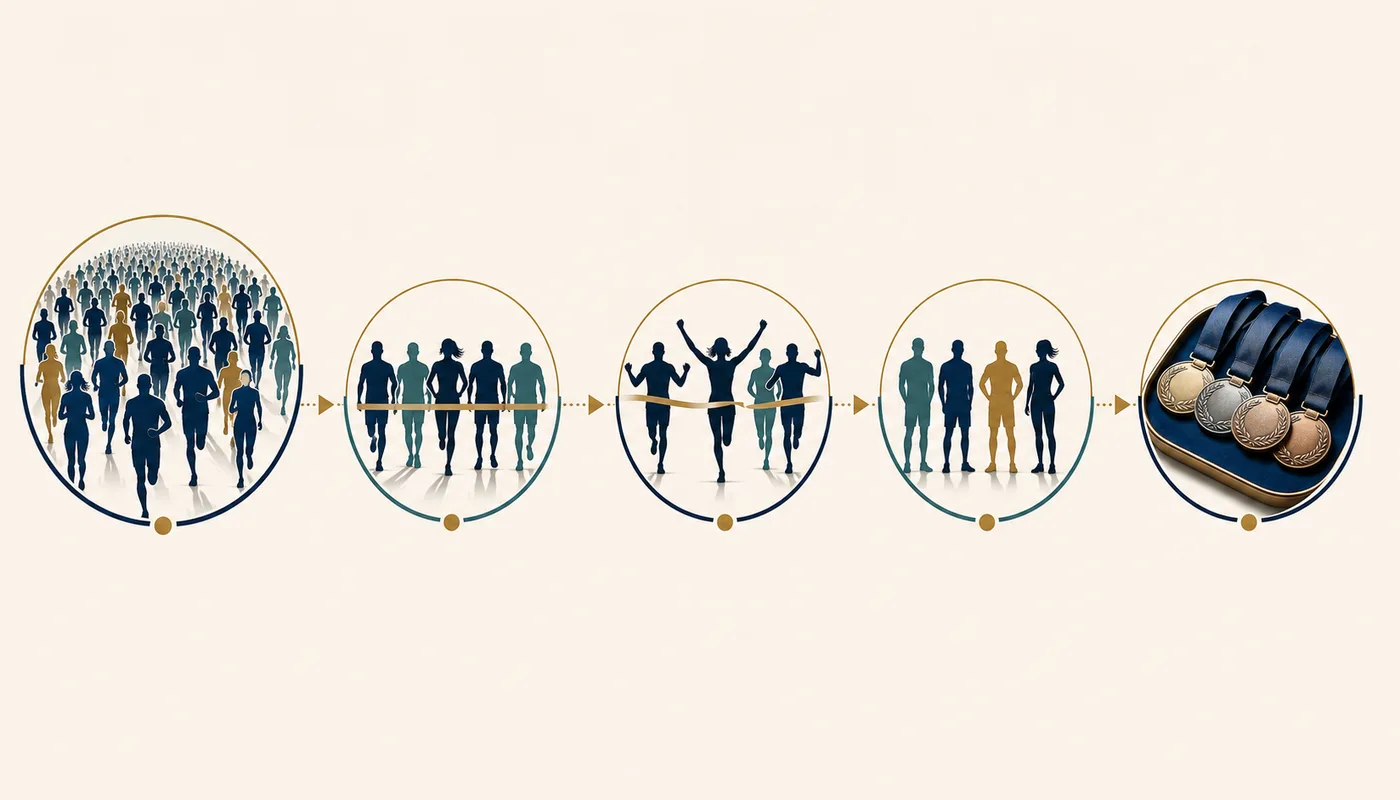
For a typical running event, the useful planning funnel is:
Projected registrations → expected starters → expected finishers → eligible medal recipients
- Projected Registrations
- Expected Starters
- Expected Finishers
- Eligible Recipients
- Final Medal Quantity
Start with projected final registrations, then use previous editions to estimate how many entrants normally start and finish. Calculate each distance separately: a community 5K and a trail half marathon may have different attendance and completion patterns.
For a first-year event, avoid presenting a single guess as certainty. Prepare three scenarios:
| Scenario | Purpose | Appropriate assumption style |
|---|---|---|
| Low | Tests the risk of excess inventory | Cautious registration and attendance forecast |
| Base | Most likely planning case | Current registration pace and comparable-event evidence |
| High | Tests shortage risk | Strong late registration and high attendance |
Record why each assumption was chosen. The purpose is to understand how the order changes when the assumptions move.
A Practical Race Medal Quantity Calculator
Use one row for every medal version. A basic worksheet can contain these fields:
| Distance or category | Projected registrations | Expected start rate | Expected finish rate | Eligible recipients | Late entries | Additional recipients | Operational reserve | Final quantity |
|---|---|---|---|---|---|---|---|---|
| 5K | Input | Input | Input | Calculated | Input | Input | Input | Calculated |
| 10K | Input | Input | Input | Calculated | Input | Input | Input | Calculated |
| Half marathon | Input | Input | Input | Calculated | Input | Input | Input | Calculated |
The underlying calculation can be written as:
Eligible recipients = projected registrations × expected start rate × expected finish rate
Then add confirmed groups and the documented reserve. Round up to a whole unit and confirm production requirements before approval.
If every registrant receives a medal, do not apply start and finish rates. If medals are limited to eligible finishers, do not count every registration. The worksheet must reflect the policy.
Worked Example: A Community 5K
Assume a community 5K projects 600 registrations. Its own past data indicates an 88% start rate and a 98% finish rate among starters. It has promised medals to 20 volunteers.
This illustrative calculation would be:
- Expected starters: 600 × 0.88 = 528
- Expected finishers: 528 × 0.98 = 517.44, rounded up to 518
- Official volunteers: 20
- Operational reserve selected by the organizer: 15
- Replacement and archive stock: 7
- Illustrative final quantity: 560 medals
These rates and reserves are sample inputs, not recommendations. A first-time race should compare low, base and high scenarios.
Multi-Distance Events Need Separate Counts
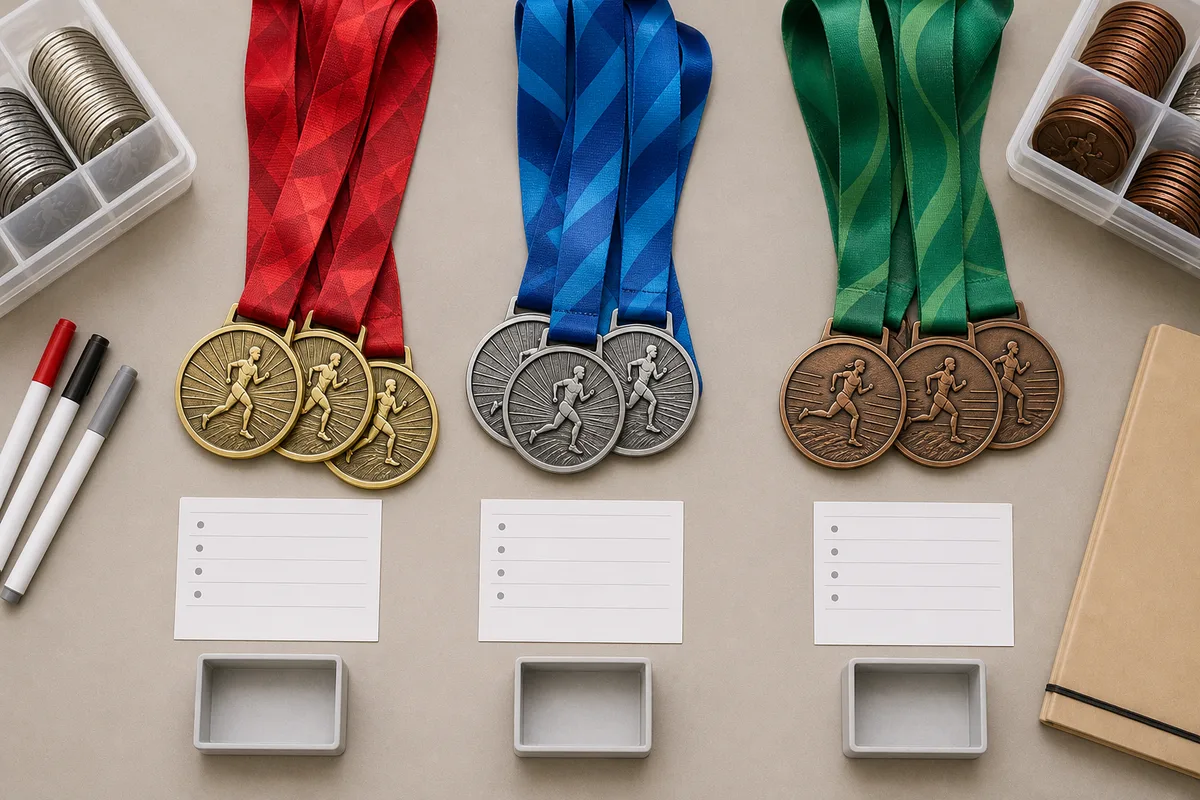
Do not use one combined total when distances have different medals, ribbons or packaging. A surplus of 5K medals cannot solve a half-marathon shortage.
- 5K Medal
- 10K Medal
- Half-Marathon Medal
Create a version map before confirming the order:
| Version | Eligible recipients | Other recipients | Reserve | Quantity to approve |
|---|---|---|---|---|
| 5K medal | 420 | 10 | 15 | 445 |
| 10K medal | 260 | 5 | 15 | 280 |
| Half-marathon medal | 180 | 5 | 10 | 195 |
These figures are illustrative. Check artwork, ribbons, carton labels and packing lists against the same version map.
Calculate Placement and Age-Group Medals Separately
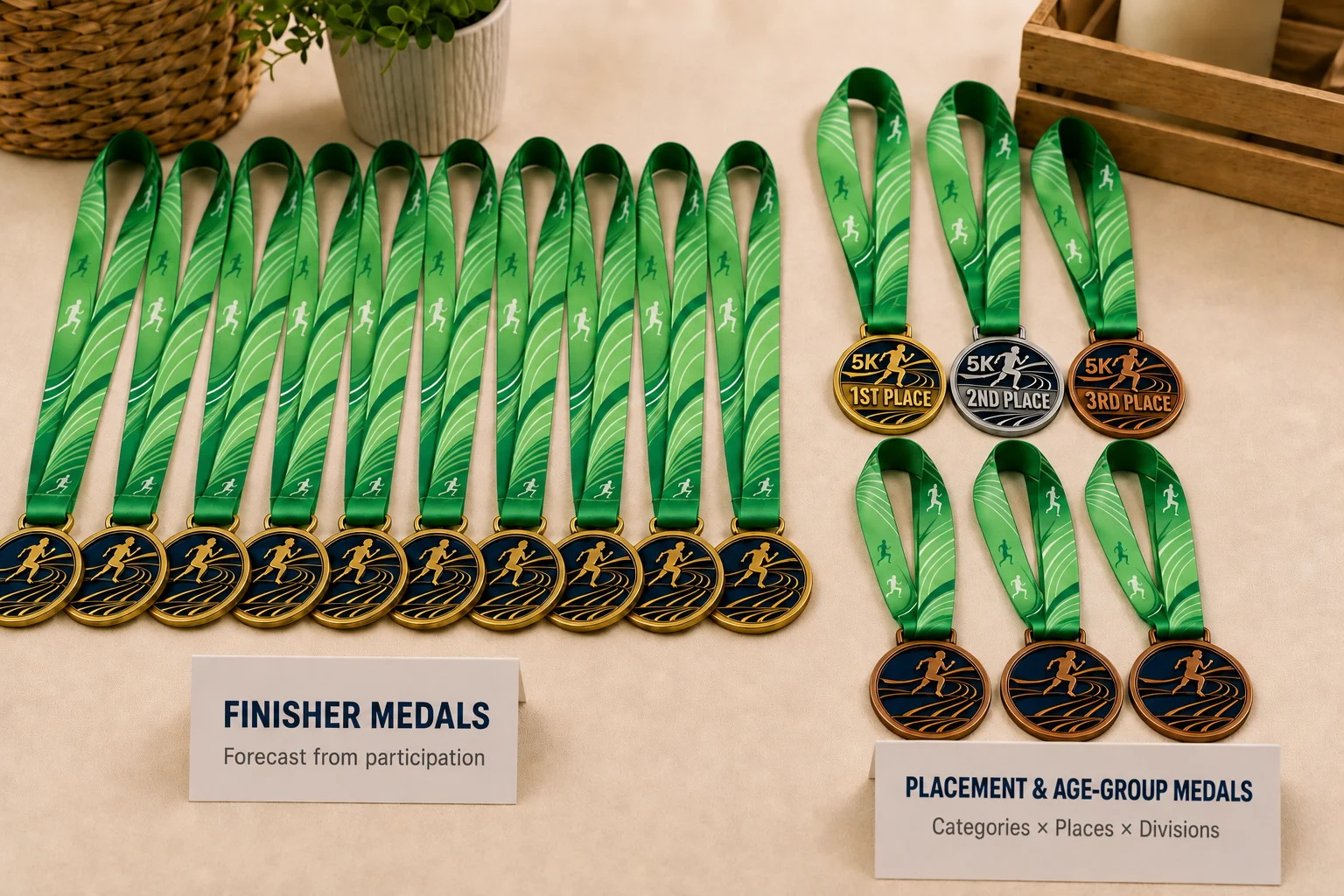
Finisher medals are forecast from participation. Placement awards are normally calculated from the published award structure.
Use:
Placement medals = award categories × places per category × divisions
Suppose an event recognizes first, second and third place in five age groups for two divisions. The age-group requirement is:
5 age groups × 3 places × 2 divisions = 30 medals
Three overall places in two divisions add six awards. Before finalizing the total, decide whether an overall winner may also receive an age-group award and publish that rule.
For teams or relays, count eligible roster members, substitutes and any included coaches for each winning place.
For a fuller distinction between these award types, see our guide to finisher medals vs placement medals.
How Large Should the Finisher Medal Reserve Be?
One fixed percentage can hide the reasons a reserve is needed. Build it from identifiable risks:
- Registration remains open after the quantity lock date.
- On-site registration is permitted.
- Forecast accuracy is weak because the event is new.
- Several distances use similar-looking medals that may be sorted incorrectly.
- Ribbons or medals could be damaged during unpacking and distribution.
- The event has promised replacements for verified damage or loss.
- Sponsor, volunteer or media allocations are not yet final.
When an event is close to its cap, planning against that cap may be safer than relying on no-shows. When attendance history is stable, a finisher forecast may be more useful. Document the choice.
What If Registration Is Still Open?
Set a quantity-lock date and work backward from the date the medals must be in hand. At that checkpoint, record:
- Current paid registrations by distance
- Recent registration pace
- Marketing campaigns still scheduled
- Registration capacity and closing date
- Whether transfers, deferrals and late entries are allowed
- Whether another production batch is operationally realistic
Do not assume an emergency reorder can rescue race day. Production and transportation still take time. Consider a soft cap, waiting list or clearly stated post-event delivery policy when entries remain open.
Plan the Race-Day Distribution
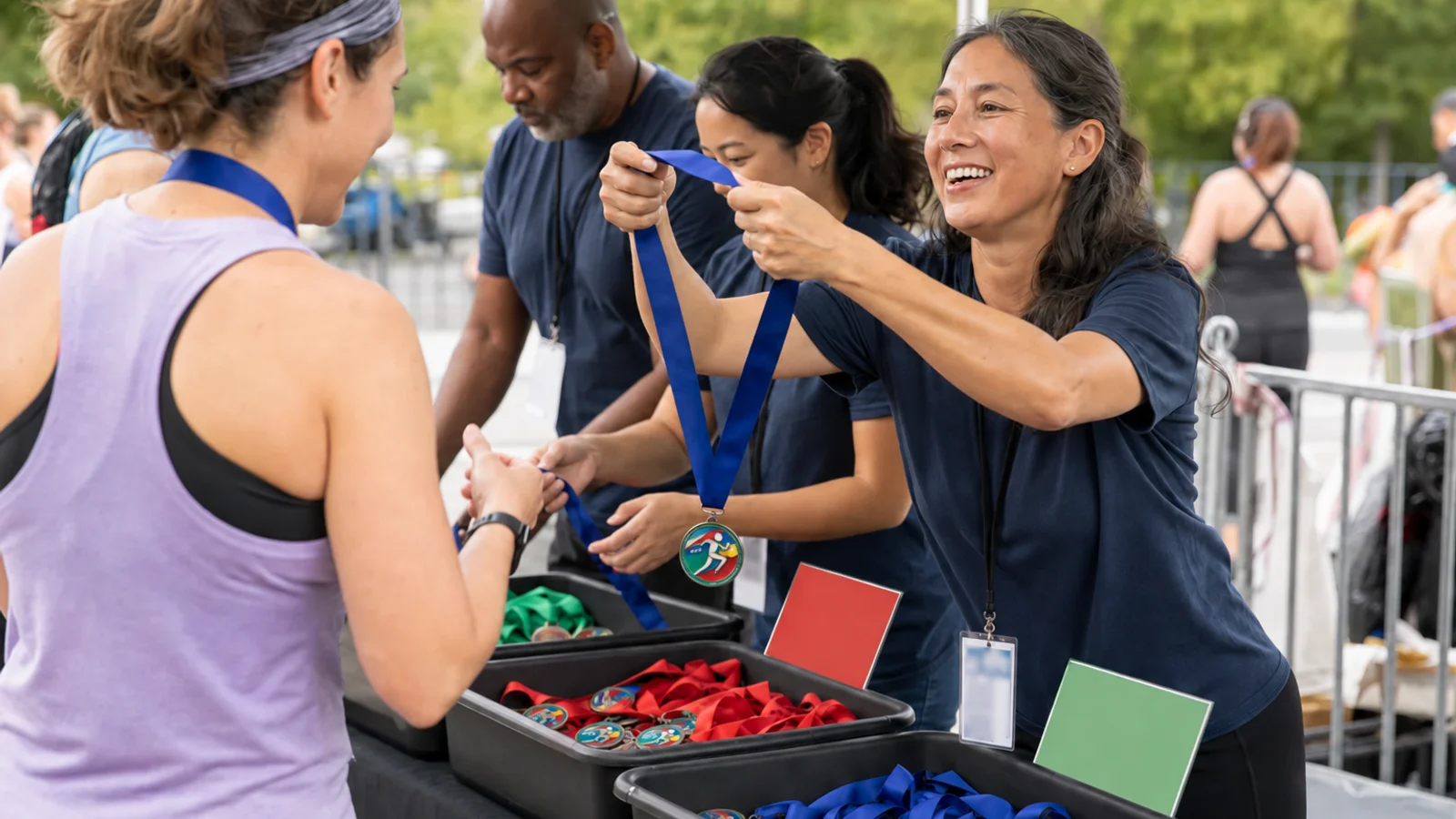
Medals can still be lost through poor sorting or an unclear handout process. Before race day:
- Label cartons and trays by distance, category and version.
- Store finisher medals separately from placement awards.
- Give volunteers a simple visual handout sheet.
- Count stock when cartons arrive and again when trays are prepared.
- Keep replacement stock away from the main finish chute.
- Assign one person to record shortages, damage and approved replacements.
- Verify results before distributing placement and age-group awards.
For virtual participants, publish completion and mailing requirements and record their inventory separately.
What Should You Do With Leftover Medals?
Hold enough pieces for legitimate replacements and an archive sample. Do not reuse a medal carrying a particular year, race or result in a misleading context. Record remaining stock so the next forecast can distinguish registration, eligibility and distribution errors.
Final Ordering Checklist
Before approval, confirm:
- Medal eligibility is written and published.
- Every distance and award version has a separate count.
- Registration, start and finish assumptions are documented.
- Volunteers, pacers, guides and other promised recipients are counted.
- Overall, age-group and team awards are calculated separately.
- The reserve has a stated purpose rather than an unexplained percentage.
- Artwork labels match the quantity worksheet.
- The in-hands date leaves time for counting and sorting.
- A shortage and replacement policy has been agreed internally.
Once the number is stable, include the event date, medal versions and design requirements in the quotation request. Review our marathon medal size, ribbon and finish guide or explore custom medals.
Frequently Asked Questions
Should I order a medal for every registered runner?
Only if that matches the event's policy or registration is the safest planning ceiling. Otherwise forecast eligible finishers, then add separately counted recipients and a documented reserve.
How many extra finisher medals should I order?
There is no universal figure. Build the reserve from open-registration uncertainty, data quality, operational risks, additional recipients and replacement commitments.
Should a DNF participant receive a medal?
That is an event-policy decision. State the rule before registration and apply it consistently.
How many race medals should I order for a 5K?
Estimate eligible finishers, then add late entries, promised recipients, an operational reserve and replacement stock.
Can one medal design cover several race distances?
Yes, if one shared design is intentional. Distances can also be differentiated through ribbons, reverse details or packaging. Use a version map so volunteers distribute the correct pieces.
What happens if the event runs out of medals?
Record affected participants and communicate only a verified remedy and realistic delivery expectations. Afterwards, compare the forecast with actual eligibility and distribution records.
Plan Custom Race Medals With a Clear Quantity Brief
Send your event type, medal versions, estimated quantities, artwork status and in-hands date so the quotation can reflect the real distribution plan.