
Custom Graduation Medals: One for Every Graduate or Separate Honors?
 By Sunny Huang

Imagine a high school preparing to recognize 180 graduating students, 15 of whom have been selected for special honors. The graduation committee wants every student to feel included while giving academic and other achievements the recognition they deserve. Should everyone receive the same graduation medal? Should medals be reserved for honorees? Or could a combination of both work better?
The decision affects more than the number of medals ordered. It determines what each award communicates, how students are recognized during the ceremony, and whether different medals feel like part of the same school tradition. This guide compares the available approaches and helps schools decide which best fits their graduation program.
In This Guide
Should Every Graduate Receive a Medal?
Not necessarily. Schools can give every graduate a commemorative medal, reserve medals for designated honors, or combine both approaches. Some schools also use special honor versions in place of standard medals rather than giving students two. The appropriate choice depends on the school's recognition policies and ceremony traditions.
What Should a Graduation Medal Recognize?
Graduating from high school is an accomplishment shared by the entire class. A commemorative medal can mark that milestone without comparing one student's performance with another's. An academic honor medal serves a different purpose: it identifies an achievement that meets criteria established by the school.
Recognition can also extend beyond grades. An Academic Excellence award may acknowledge scholastic performance, while a Leadership Award could recognize contributions to student organizations. A Community Service award might recognize sustained involvement in projects benefiting others. Such distinctions are most useful when the school can explain what students did to earn them.
Before selecting medal designs, the graduation committee should agree on the awards it intends to present and the reasons behind them. The school's recognition policy—not the availability of different medal styles—should determine the categories.
When Is One Shared Graduation Medal Enough?
A single design works well when the main purpose is to celebrate the graduating class as a whole. Students may have followed different academic paths, participated in different activities, and earned different distinctions. A shared medal recognizes something they have in common: completing an important stage of their education.
School-specific details can make that keepsake recognizable years later. A school crest, the graduation year, and a simple inscription such as "Class of 2027" connect the award to a particular place and moment. Presenting the same medal to the entire class can also create a consistent appearance during the ceremony and in group photographs.
A shared medal does not need to communicate every achievement. For example, a school that already recognizes academic distinction through honor cords, certificates, or a separate presentation may have no reason to introduce additional medal versions. If the medal's purpose is to commemorate graduation rather than distinguish honors, one design may be sufficient.
When Do Separate Honors Deserve Their Own Medals?
Separate graduation honor medals become more useful when a school wants a particular achievement to have a distinct identity. Valedictorian and Salutatorian are examples of academic distinctions recognized by some schools. Others may present subject-specific honors, leadership awards, or recognition for community contributions. Whether these distinctions warrant dedicated medals depends on the school's existing recognition program.
Three questions can guide that decision: Does the honor have an official title and clear eligibility criteria? Will the student receive separate recognition during the ceremony? And would a medal communicate something that the school's existing awards do not? If the achievement is already represented by an honor cord or another keepsake, a further medal may be unnecessary. Where a dedicated memento matters, a separate medal offers another way to commemorate that distinction.
Schools should not assume that different honors must follow a gold, silver, and bronze ranking. Academic Excellence and Community Service, for instance, recognize different contributions rather than necessarily different levels of accomplishment. Award titles, symbols, and distinctions should follow school-approved criteria. Valedictorian, Salutatorian, and other honor designations are determined by individual school policies, not a universal U.S. medal-color system.
Three Graduation Award Models—and Their Trade-Offs
Once the award categories are established, schools can choose how medals will be distributed. Three general models cover many situations, although the combined approach allows two different ways of recognizing honor students. These distinctions matter because they change both the ceremony experience and the actual number of medals needed.
| Award Model | How It Works | Main Advantage | Consideration |
|---|---|---|---|
| Model A: One Medal for All | Every graduate receives the same commemorative medal. | Celebrates a common milestone with a consistent presentation. | Special honors are recognized separately, if required. |
| Model B: Honor Medals Only | Medals are reserved for students receiving designated honors. | Gives medals a specific role within the school's recognition program. | Other graduates do not receive a medal as a graduation keepsake. |
| Model C: Shared Medal + Honor Recognition | Every graduate is recognized, while honorees receive either an additional medal or a distinct version. | Combines a shared graduation identity with individual recognition. | The school must decide whether honor medals supplement or replace standard medals. |
Model C has two possible arrangements:
- Additional honor medal: Every graduate receives a standard commemorative medal. Selected students also receive a separate medal for their special achievement.
- Replacement honor version: Students without designated honors receive the standard medal, while honorees receive a distinct honor version instead. Each student receives one medal.
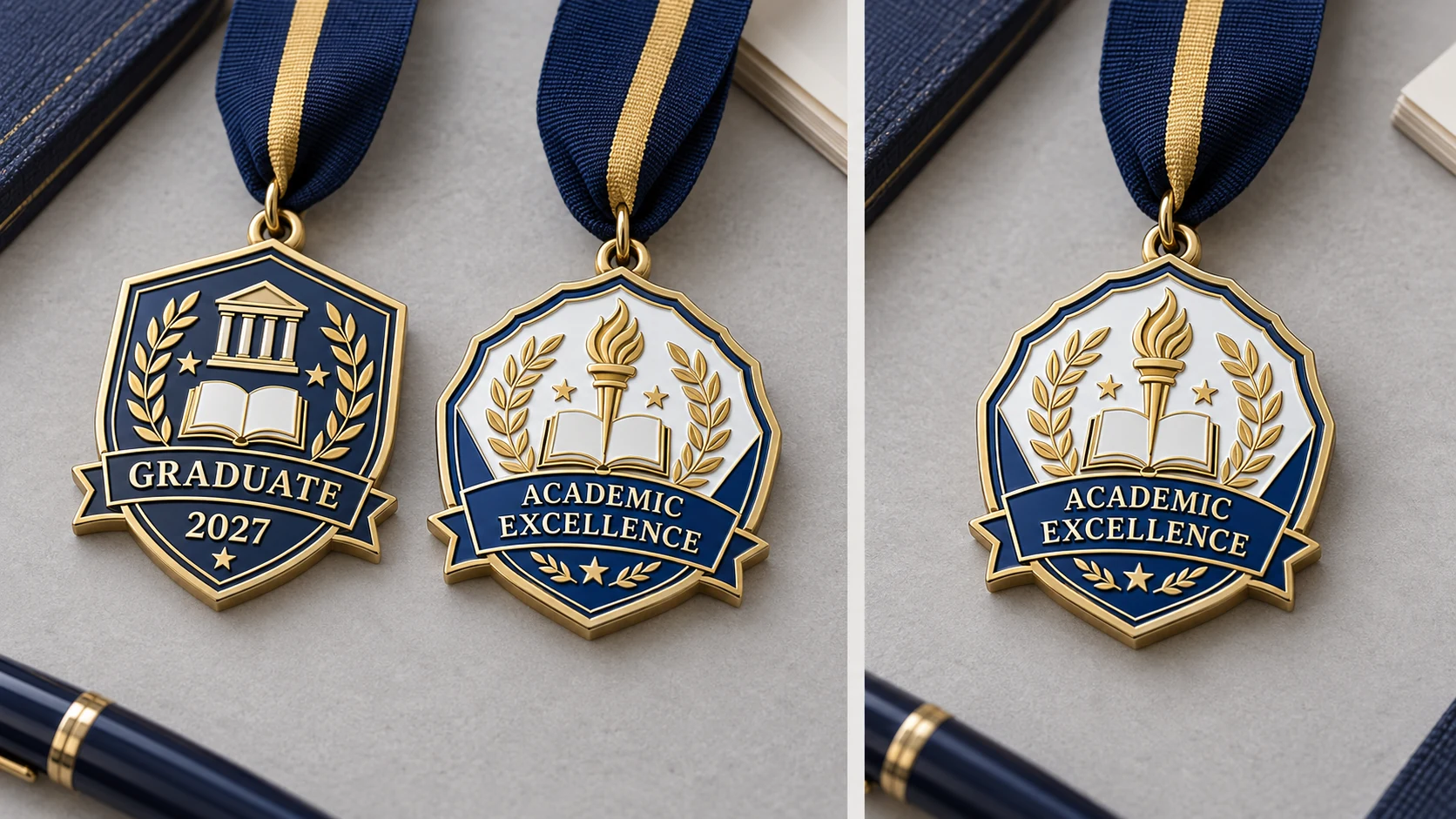
Neither arrangement is automatically better. Additional medals make it possible to acknowledge a shared milestone and a separate achievement independently. Replacement versions avoid presenting two medals to the same student while preserving a visible distinction. Schools should choose according to their existing recognition practices, ceremony arrangements, and resources—not because one option produces a larger order.
One School Identity, Four Distinct Medal Designs
Choosing different award categories does not mean creating unrelated designs. A shared school crest, school name, graduation year, and consistent medal outline can connect each version to the same institution. Students and families should be able to recognize the collection as belonging to one graduating class, even when the individual awards communicate different achievements.
The distinctions can appear in the award titles and central artwork. A book and laurel motif might accompany Academic Excellence, while a torch could represent Leadership. Community Service could use a simple helping-hands symbol. Subtle changes in color can make the versions easier to identify, particularly when the school has approved colors for its recognition program. These choices should communicate the nature of the achievement without suggesting an unintended ranking.
If school colors also need to distinguish award categories, our custom medal ribbon guide explains how plain and printed ribbons can support different medal designs.
Consider an illustrative collection for a fictional school:
| Medal Version | Recognition Purpose | Distinctive Artwork |
|---|---|---|
| Graduate 2027 | Completion of high school | Graduation year and school emblem |
| Academic Excellence | Outstanding academic achievement | Book and laurel motif |
| Leadership Award | Contributions through student leadership | Torch symbol |
| Community Service | Contributions to community activities | Helping-hands motif |
Once the award names and designs are approved, our medal artwork approval guide covers the details to review before production.
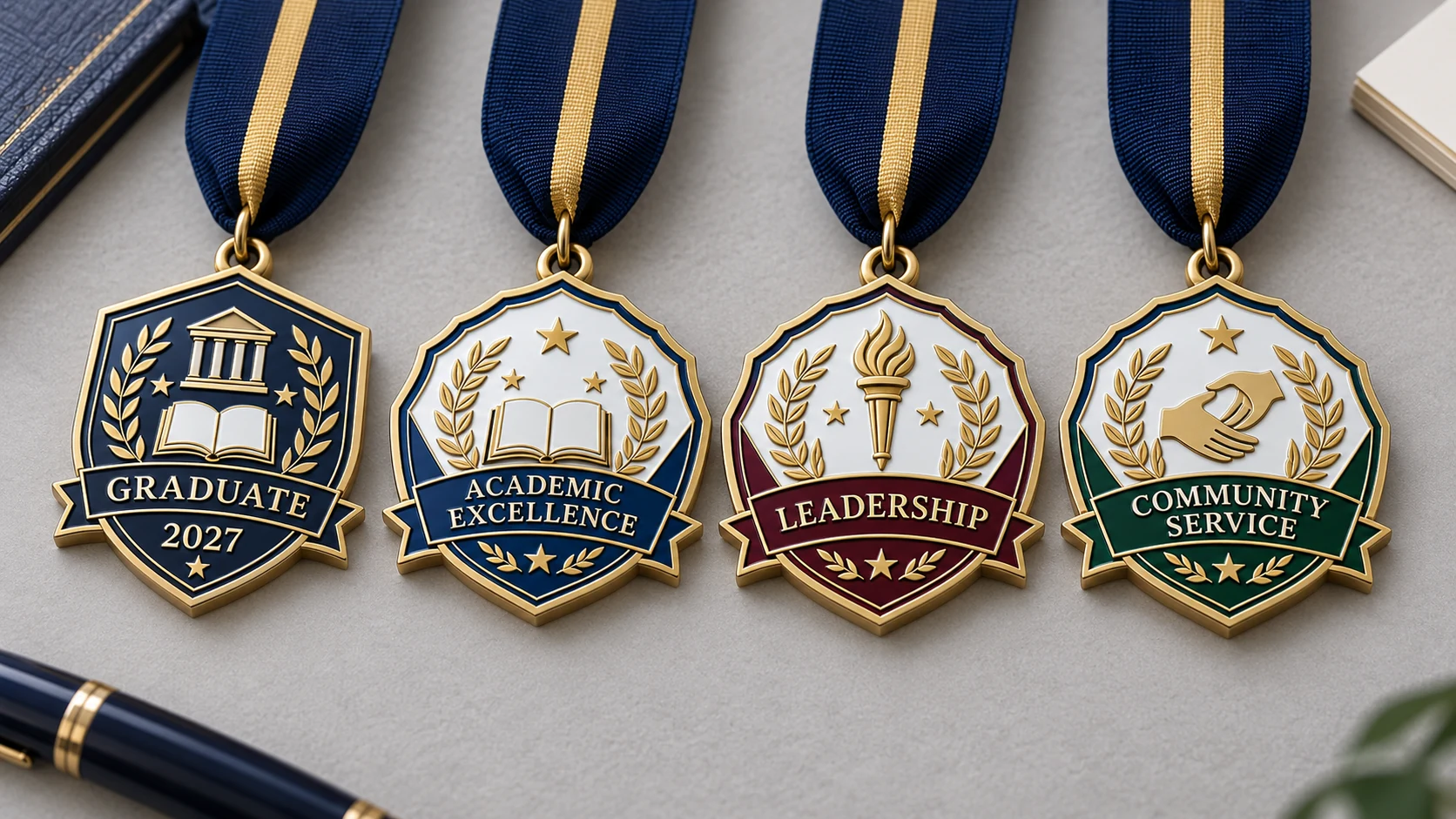
All four versions could share the same crest, shape, and overall visual language. The result would be a recognizable graduation collection rather than four unrelated awards.
Schools exploring this approach can review different possibilities in our Custom Medals collection. The purpose of customization is not simply to make each medal look different, but to give every approved award a distinct and understandable identity.
Which Model Works for Your Graduating Class?
Return to the hypothetical school with 180 graduates and 15 students selected for special honors. For this example, assume each honoree is entitled to one honor medal and no student receives more than one honor category. The number of medals changes depending on whether honor recognition replaces or supplements the standard graduation medal.
| Award Arrangement | Standard Graduation Medals | Honor Medals | Total Pieces |
|---|---|---|---|
| Model A: One Medal for All | 180 | 0 | 180 |
| Model B: Honor Medals Only | 0 | 15 | 15 |
| Model C1: Standard + Additional Honor Medal | 180 | 15 | 195 |
| Model C2: Honor Version Replaces Standard Medal | 165 | 15 | 180 |
The difference between 195 and 180 medals in the two combined arrangements is not merely a purchasing detail. Under C1, each honoree receives two separate keepsakes. Under C2, the honor version takes the place of the standard medal. That decision may affect how awards are announced and presented onstage.
Before determining quantities, the committee should confirm whether students can receive multiple honors, whether each honor requires a separate medal, and how the presentation will work alongside diplomas and other graduation accessories. A clear recognition plan provides a more reliable basis for choosing medal versions than simply estimating the total graduating class.
Frequently Asked Questions About School Graduation Medals
Can one student receive more than one honor medal?
Yes, if the school's recognition policy allows separate medals for multiple achievements. The committee should determine whether each honor requires an individual award and how those awards will be presented.
Should schools use medals if they already award honor cords?
They can, but it is not always necessary. Honor cords may provide sufficient recognition during commencement, while medals can serve as school-specific keepsakes. Their purposes should be distinct.
What if the final honor recipients have not been confirmed?
Schools can establish shared design elements and award categories before individual names are finalized. Any personalized details should remain subject to the school's final approval and the manufacturer's confirmed production arrangements.
A Medal Should Reflect What the School Wants to Recognize
Graduation medals have different roles depending on whether a school is celebrating every graduate, recognizing selected achievements, or combining both. The most suitable approach begins with a clear recognition policy and leads to medal designs that communicate it.
Schools and distributors planning a graduation medal collection can share their estimated graduate numbers, award categories, school emblem, and ceremony date with Unique Pin. Even if the final arrangement has not been decided, these details provide a useful starting point for discussing design options.
Planning Graduation Medals for Your School?
Whether you need one shared design or a coordinated series of graduation honor medals, we can discuss options based on your school's recognition program.