Corporate Challenge Coins: How to Build an Employee Recognition Program
 By Sunny Huang
Corporate challenge coins can give employee recognition a physical form, but the coin is only one part of the program. The meaning comes from what the organization recognizes, how consistently it applies the rules and how the award is presented.
The short answer: Start by defining a specific achievement, behavior or milestone. Set clear eligibility and approval rules, decide whether recognition is for individuals or teams, and then design the coin around that purpose. Plan the presentation, quantity and recordkeeping before placing the order. A well-designed coin can preserve the story of an achievement; it cannot make vague or unfair recognition meaningful.
What Are Corporate Challenge Coins?
Corporate challenge coins are custom metal coins used by companies to mark achievements, service milestones, leadership contributions, completed projects or shared organizational events. They are associated with service and membership traditions, but a corporate program does not need to copy military language or ceremony.
Unlike a general promotional giveaway, an employee recognition coin should have a defined reason for being awarded. The recipient should be able to explain what the coin represents, who presented it and what they did to earn it. That context is more important than adding an expensive finish or filling every part of the design with text.
A coin can serve as a symbolic award, but it should complement—not replace—fair compensation, useful feedback, development opportunities or appropriate performance management.
Step 1: Decide What the Program Will Recognize
Do not begin with artwork. Write one sentence explaining the program’s purpose. It might:
- recognize a documented example of a company value;
- mark a service milestone;
- thank a team after a defined project;
- recognize mentoring, customer service or process improvement; or
- acknowledge a verified preventive safety action.
Keep each category specific enough that employees understand what qualifies. “Excellence” is difficult to judge on its own; a documented action gives managers and employees something observable.
Safety recognition needs particular care. Rewarding only an incident-free period may discourage reporting. Consider verified preventive actions, training or hazard identification instead.
Step 2: Set Rules Employees Can Understand
Recognition loses credibility when the criteria change between teams or depend entirely on which manager notices the work. Before launch, document:
- Who is eligible, including different locations and work patterns.
- Who may nominate and what evidence is required.
- Who approves an award and handles conflicts of interest.
- When awards are reviewed or presented.
- Whether the same award can be received more than once.
A short nomination form may record the employee, value or milestone, action and date. The same basic standard should apply across departments.
Gallup and Workhuman identify five qualities of effective recognition: it should be fulfilling, authentic, equitable, embedded in the culture and personalized. Their workplace-recognition research concerns recognition broadly, not coins specifically, but the framework is useful here. A polished object will not compensate for favoritism, an impersonal presentation or criteria that employees cannot see.
Step 3: Choose a Structure That Fits the Achievement
The program may use one coin or a small, controlled series:
| Program type | Suitable coin structure | Important control |
|---|---|---|
| Values-based recognition | One design per selected value | Define observable examples for each value |
| Service milestones | Consistent design with year differences | Verify employment dates before ordering personalized pieces |
| Project completion | Project identity on one side and company identity on the other | State what counts as project completion |
| Team recognition | Shared design for all eligible team members | Include less-visible contributors, locations and shifts |
| Leadership or mentoring | Award tied to documented contributions | Do not confuse seniority with demonstrated behavior |
Avoid too many categories at launch. A pilot with one or two award types is easier to explain and review.
Step 4: Turn the Recognition Story Into a Coin Design
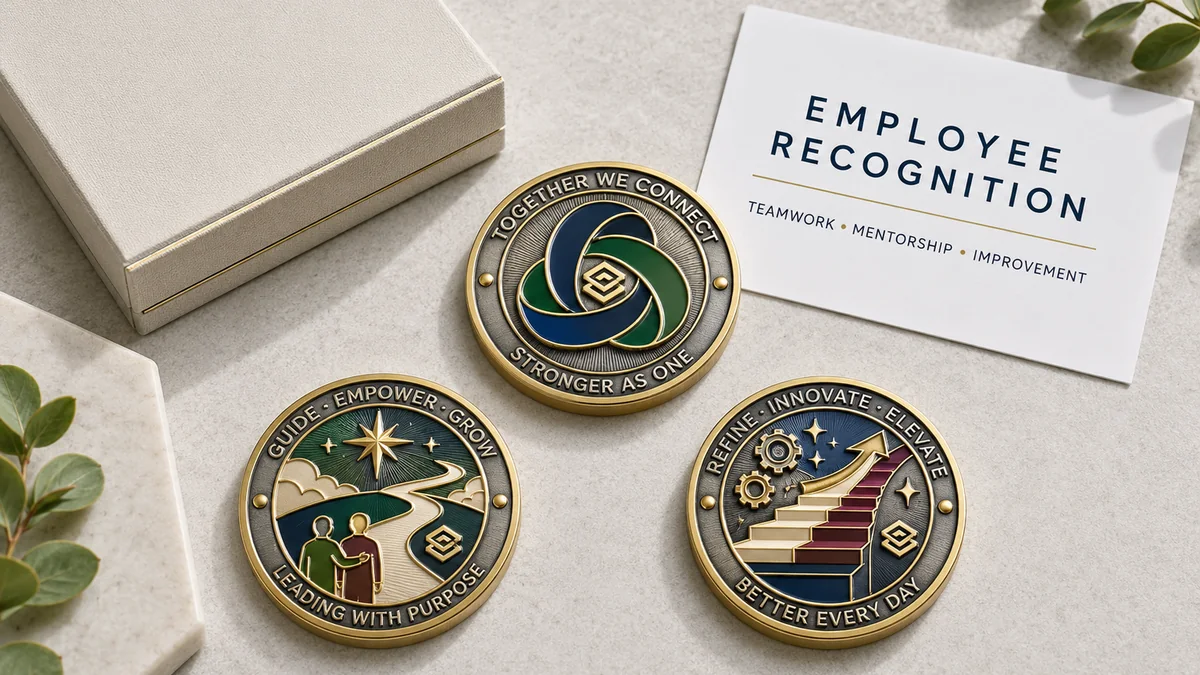
A practical two-sided layout is:
- Front: company or program identity, with one dominant emblem.
- Back: the recognized value, milestone, project or short message.
- Optional details: year, department, sequential number or recipient name when the program requires them.
Keep essential wording readable at the finished size. Long mission statements, multiple logos and detailed illustrations compete for space. Decide which element must be seen first.
Flat logos, lettering and separated brand colors often work well in 2D, while portraits, buildings or sculpted subjects may justify 3D relief. The 2D vs 3D challenge coin guide explains that choice in detail. If size is undecided, review the challenge coin size and thickness guide and print the proof at actual scale before approving it.
Finish and packaging should follow the presentation method. Bright plating can suit a modern brand, while an antique finish may make recessed relief easier to see. A pouch supports simple distribution; a fitted box may suit a formal award. These are choices, not fixed rules.

Step 5: Plan the Presentation, Not Just the Product
A short presentation note should answer:
- What did the employee or team do?
- Why did it matter?
- What does the coin’s symbol represent?
Public recognition is not automatically better. Some employees value a team announcement; others prefer a private conversation. Ask about preferences when possible, especially before using photographs or social media. Include remote, shift-based and on-site employees in the same program logic.
Step 6: Plan Quantities, Personalization and Reorders
Separate standard stock from personalized pieces. Reusable coins can be tracked as inventory; names, dates or serial numbers require an accurate recipient list and another proof check.
Before requesting a quote, prepare:
- purpose and recipient group;
- front and back artwork or a design brief;
- names, dates, numbers and verified spelling;
- diameter, thickness, finish and packaging preferences;
- estimated quantity and possible reorders;
- required arrival date and destination.
Keep the approved artwork, specification and version history together if the design may return next year. UCCrafts’ guide to how custom challenge coins are made shows where approval and production checks fit into the wider process.
Step 7: Pilot and Review the Program
Run a limited pilot before building a large series. After the first cycle, review operational evidence rather than judging the program by the ceremony alone.
Useful questions include:
- Were the criteria understood and supported by specific evidence?
- Were departments, shifts and locations represented fairly?
- Were quantities, names and delivery details accurate?
- Did managers present and record awards consistently?
Participation and distribution patterns can reveal gaps, but they do not prove that the coin changed engagement, productivity or retention. Combine program records with employee feedback and existing HR measures.
Common Mistakes to Avoid
- Using an earned coin as a generic giveaway. If there is no qualifying achievement, describe it as a commemorative or company coin.
- Writing vague criteria. Terms such as “excellence” and “leadership” need observable examples.
- Recognizing only visible work. Remote teams, shifts and support roles are easily missed when recognition depends on executive visibility.
- Overcrowding the artwork. Put detailed program rules in a card, intranet page or presentation note.
- Promising an outcome. No physical award guarantees motivation, loyalty or performance.
- Ordering before approval. Confirm every name, date and specification on the digital proof.
A Practical Starting Point
The strongest employee recognition challenge coins are attached to a clear decision: what is being recognized, why it matters and how the recipient was selected. Establish those rules first. Then use the coin’s two sides, relief, color and presentation to preserve that story in a compact form.
If your organization is planning a service, values, project or leadership program, prepare the purpose, audience, quantity, artwork and presentation date before contacting a supplier. You can then review available custom challenge coin options against the actual needs of the program instead of choosing specifications in isolation.
Frequently Asked Questions
What should an employee recognition challenge coin include?
Include a clear company or program identity and the specific value, achievement or milestone being recognized. A year, department, recipient name or serial number can be added when it has a defined role. Avoid long text that will be difficult to read at the finished size.
Are corporate challenge coins a replacement for bonuses or other awards?
No. They are symbolic recognition items. Organizations should decide separately how coins relate to compensation, benefits, formal performance awards and local employment or tax requirements.
How early should a company order recognition coins?
There is no universal lead time. It depends on artwork readiness, design complexity, proof revisions, quantity, finishing, packaging and shipping destination. Start from the required presentation date, request a project-specific schedule and leave time for internal approvals and delivery risk.