
Challenge Coin Size and Thickness Guide: How to Choose the Right Dimensions
Choosing the right challenge coin dimensions is not simply a matter of selecting the largest diameter available. Diameter controls the space for text, logos, borders, enamel colors and relief. Challenge coin thickness changes the edge profile, weight and physical presence of the finished coin.
For many projects, 1.75 inches and 2 inches are useful reference sizes, not universal standards. A clean emblem may work at 1.75 inches, while detailed double-sided artwork or 3D sculpting may need 2 inches or more. Before tooling, print the proof at actual size and verify both the edge thickness and maximum 3D height.
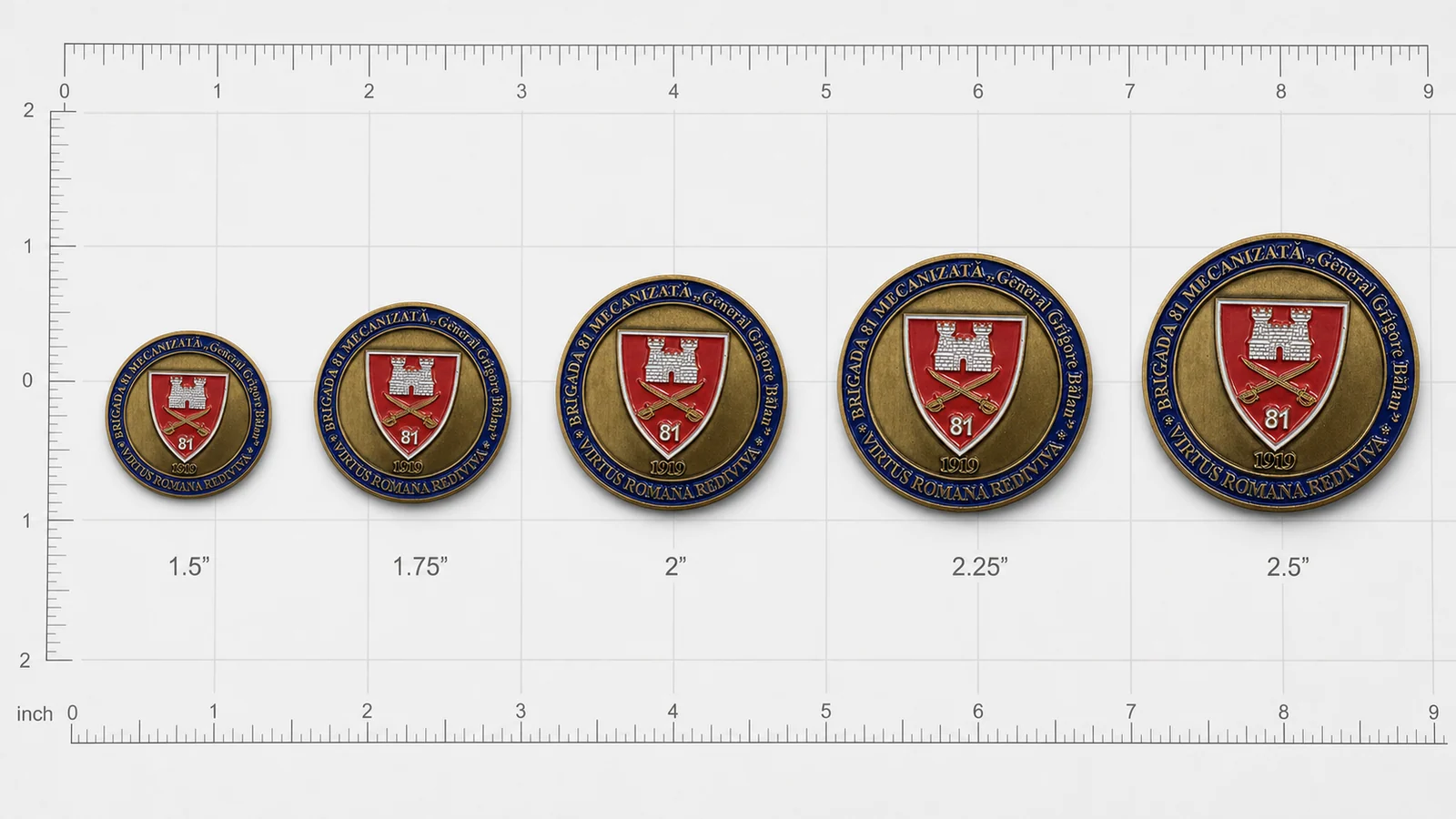
Table of Contents
Quick Answer: What Size Should a Challenge Coin Be?
Most challenge coins measure between 1.5 and 2.5 inches. A 1.75-inch coin suits pocket-carry designs with a clear emblem and limited text. A 2-inch coin gives detailed badges, two text rings and double-sided layouts more room. Consider 2.25 inches or above for complex scenes or display-focused projects.
For thickness, our current round-coin production reference ranges from 2.0 to 3.0 mm for coins measuring 25 to 45 mm in diameter, increasing to 4 mm or more for diameters of 91 mm and above. A 3 mm specification is common for conventional 2D pieces in regular carry sizes. Final dimensions should follow the approved artwork and production specification.
Challenge Coin Size Comparison Chart
| Diameter | Metric Size | Typical Use | Artwork Capacity | Carry or Display Character |
|---|---|---|---|---|
| 1.5 in | 38.1 mm | Simple tokens, compact giveaways, short wording | Limited | Light and easy to distribute |
| 1.75 in | 44.45 mm | Unit coins, club coins, concise commemorative designs | Moderate | Comfortable for regular pocket carry |
| 2 in | 50.8 mm | Detailed emblems, double-sided designs, recognition gifts | Moderate to high | Substantial without feeling oversized |
| 2.25 in | 57.15 mm | Retirement coins, vehicles, buildings, detailed badges | High | Strong visual presence for presentation |
| 2.5 in | 63.5 mm | Complex scenes, deep relief, display-focused projects | Very high | Better suited to presentation or display |
These ranges are references, not fixed manufacturing rules. Usable space also changes with border width, internal cutouts, edge text and whether the artwork uses flat 2D levels or sculpted 3D relief.
Common Challenge Coin Sizes and Their Best Uses
1.5 inches: compact and simple
A 1.5-inch coin works for short wording, a single clear emblem and cost-effective large-volume distribution. It leaves little room for small text or crowded double-sided layouts, so artwork usually needs strong shapes and fewer details.
1.75 inches: a balanced pocket-carry size
This size balances portability with enough space for an emblem, outer text ring and simple reverse design. It works well for membership, club and unit-style coins when recipients are expected to carry them regularly.
2 inches: more room without excessive bulk
A 2-inch coin provides noticeably more usable area for detailed seals, multiple text lines, dates and artwork on both sides. It also gives sculpted relief transitions more room, which is why many corporate recognition and commemorative projects begin here.
2.25 to 2.5 inches: presentation and complex artwork
Larger coins suit portraits, buildings, vehicles, layered scenes and deeper relief. The trade-off is greater weight and larger packaging requirements. These sizes are generally better for presentation boxes or display than routine pocket carry.
Is There a Standard Challenge Coin Size?
There is no single mandatory standard. Buyers and manufacturers often describe 1.75 inches as traditional and 2 inches as versatile, but both can be correct for different projects. The useful question is: what is the smallest size that keeps the important elements clear and manufacturable?
For physical context, compare the dimensions with the U.S. Mint coin specifications. Circulating coins are generally smaller and thinner than custom challenge coins. The comparison explains why a 1.75-inch or 2-inch product feels substantial, but it is not a custom manufacturing standard.
How Thickness Changes the Coin
Thickness changes the visible edge, available relief depth, packaging fit and shipment weight. It also affects how the coin sits in a capsule or fitted presentation box.
Factory reference: diameter and suggested thickness
The following ranges come from our current internal specification guidance for round commemorative and challenge coins. They provide useful quotation references before the team evaluates the artwork, relief and edge structure.
| Coin Diameter | Approximate Inch Range | Suggested Thickness |
|---|---|---|
| 25 to 45 mm | 0.98 to 1.77 in | 2.0 to 3.0 mm |
| 46 to 70 mm | 1.81 to 2.76 in | 3.0 to 3.5 mm |
| 71 to 90 mm | 2.80 to 3.54 in | About 3.5 mm |
| 91 mm and above | 3.58 in and above | 4 mm and above |
This table is not a substitute for a final specification check. Custom outlines, deep 3D subjects, bottle-opener features, moving parts or fitted packaging can require a different thickness even when the overall diameter stays within the same range.
3 mm: a common specification
A 3 mm specification is commonly used for conventional 2D coins. With production-ready artwork, it can support raised and recessed areas, enamel color and common plated finishes.
3.5 to 4 mm: more edge presence
Additional thickness can strengthen the edge profile and create more room for relief. It may suit retirement pieces, portraits, buildings or presentation coins. It does not repair weak artwork; line width, relief transitions and polishing access still need evaluation.
Edge thickness is not always maximum thickness
On a sculpted coin, a 4 mm edge may sit below the central 3D subject. The proof should state whether thickness refers to the base, the edge or the maximum relief height. Otherwise, two suppliers may interpret the same number differently.
Match Coin Size to the Artwork
The fastest check is to print the front and back proof at 100 percent scale. Do not approve only a large image on a monitor. At actual size, verify that names, dates, unit numbers and mottos remain readable and that important symbols are not competing with the border.
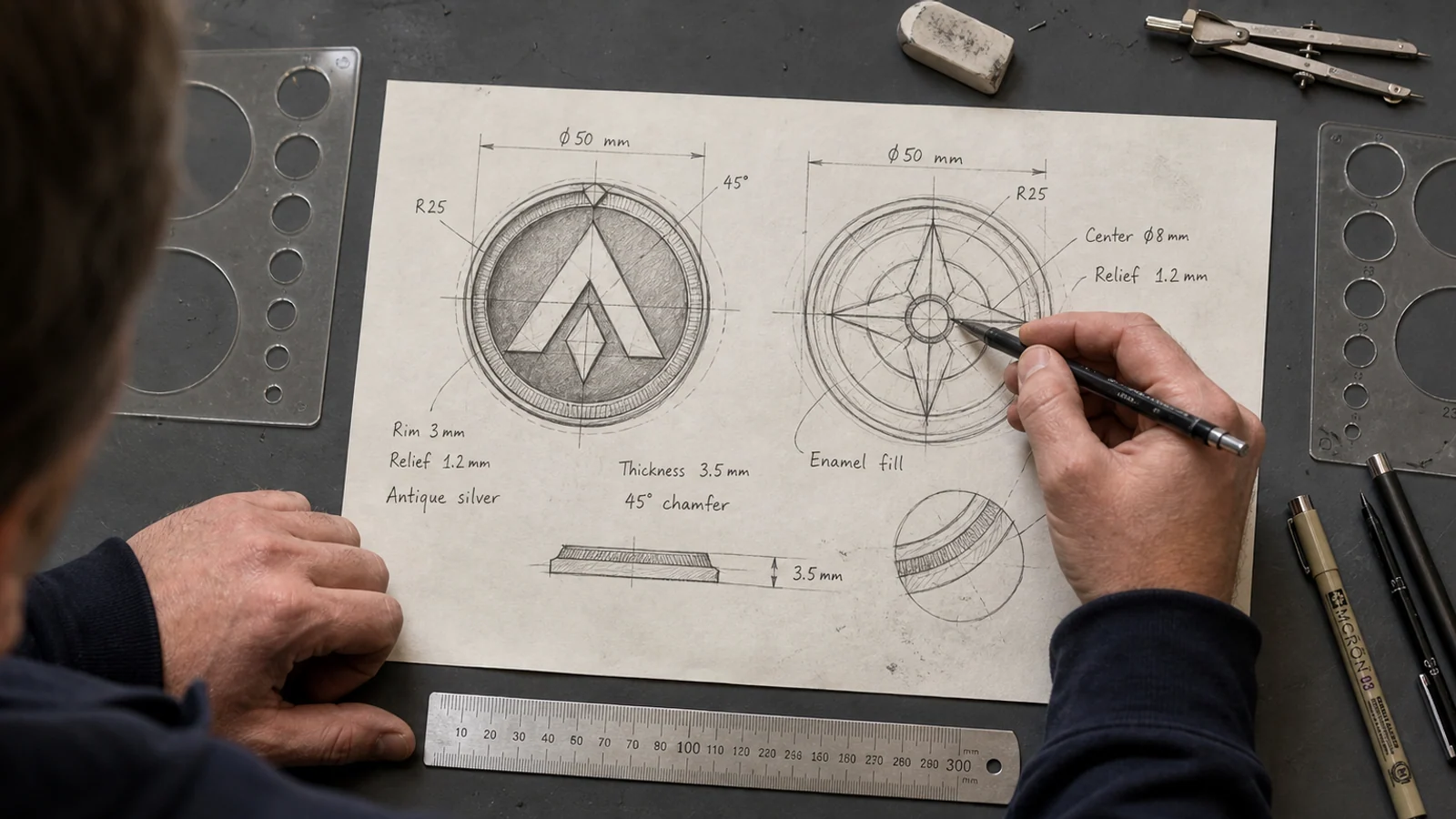
The 2D vs 3D challenge coin guide explains stepped levels and sculpted contours. Lettering and logos are often clearer in 2D, while portraits, animals, buildings and terrain may benefit from 3D treatment.
- Can the smallest wording be read without zooming?
- Is the main emblem still dominant?
- Are the front and back visually balanced?
- Do enamel areas have clear metal boundaries?
- Is there enough room for the selected edge treatment?
- Will the packaging hold the finished diameter and maximum thickness?
Not Sure Whether Your Artwork Needs 1.75 or 2 Inches?
Send the front and back design, intended use, quantity and packaging preference. We can assess the layout before tooling and recommend a suitable diameter and thickness.
Choose Size and Thickness by Application
| Application | Reference Size | Key Checks |
|---|---|---|
| Pocket-carry unit or membership coin | 1.75 to 2 in | Readable emblem, smooth outline and manageable weight |
| Corporate recognition or event coin | 1.75 to 2 in | Brand mark, date, message and packaging fit |
| Retirement, anniversary or presentation coin | 2 to 2.5 in | Portrait or scene detail, relief height and box insert |
| Functional or custom-shaped coin | Based on structure | Openings, pivots, projections, grip area and narrow metal bridges |
How Custom Shapes and 3D Relief Are Measured
For a round coin, size normally means diameter. For a shield, badge, vehicle, map or other irregular outline, the quoted size should identify the longest overall dimension. Ask the supplier to show both width and height on the proof. This prevents a narrow 2-inch design and a wide 2-inch design from being treated as though they use the same footprint.
For 3D coins, the proof should distinguish the edge thickness from the maximum height. If the coin must fit a capsule, tray, fitted box or display stand, provide the internal packaging dimensions before production. Test dimension-sensitive packaging with a finished sample or an accurate reference rather than selecting it only from the face diameter.
Factory Testing and Shipment Inspection
Real production example: batch print consistency
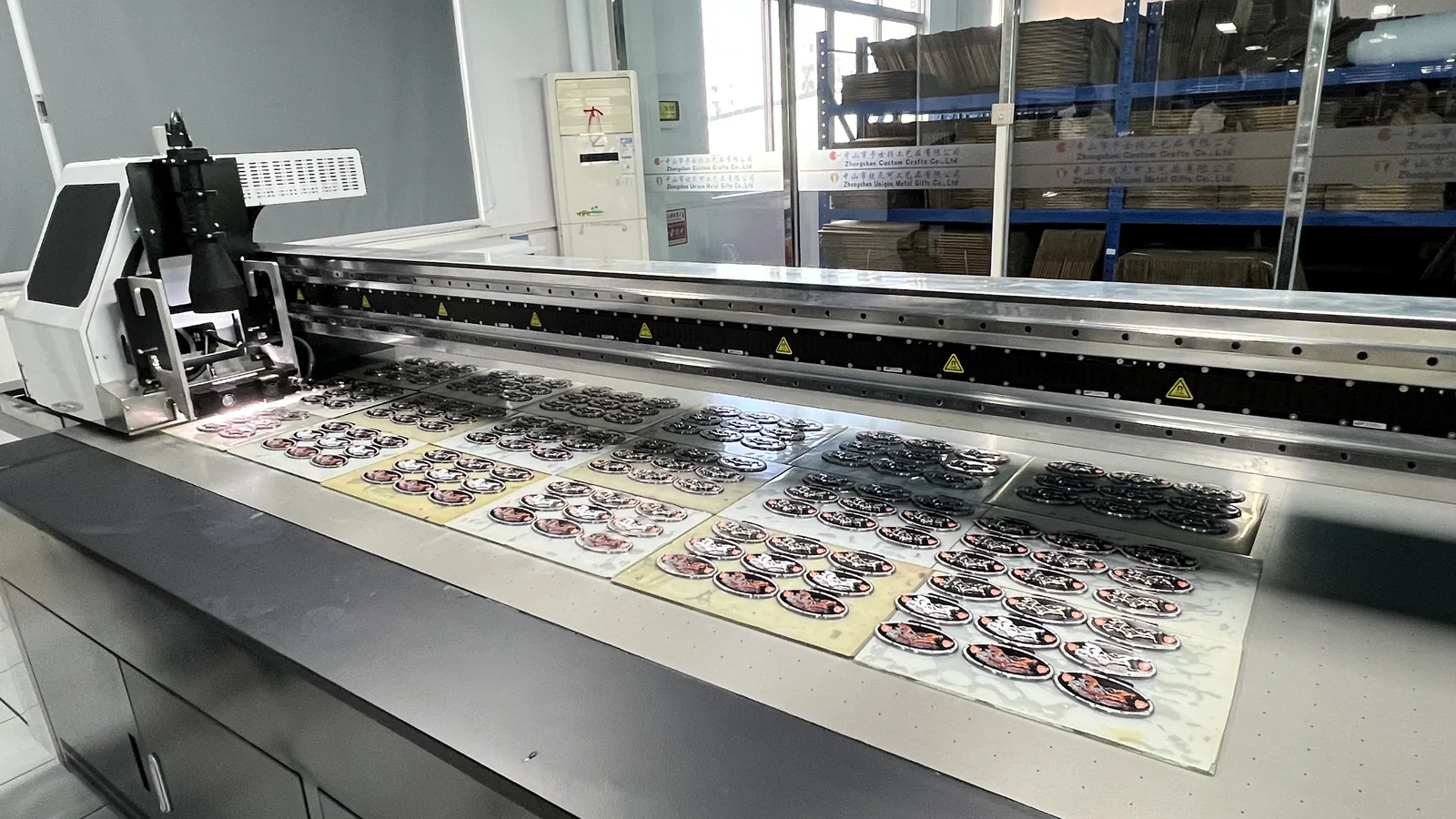
This factory photo records a batch of round metal pieces arranged in repeated rows on flat trays during machine printing. Keeping each piece in a consistent position makes it easier to compare print placement and color coverage across the batch before the pieces move to the next production stage.
The same discipline applies to size selection. A larger face gives printed artwork more room, but it does not remove the need for accurate registration. The approved proof, finished diameter and printable area must agree. During the run, the team checks whether the main subject remains centered, edge details stay clear and neighboring pieces show visible variation.
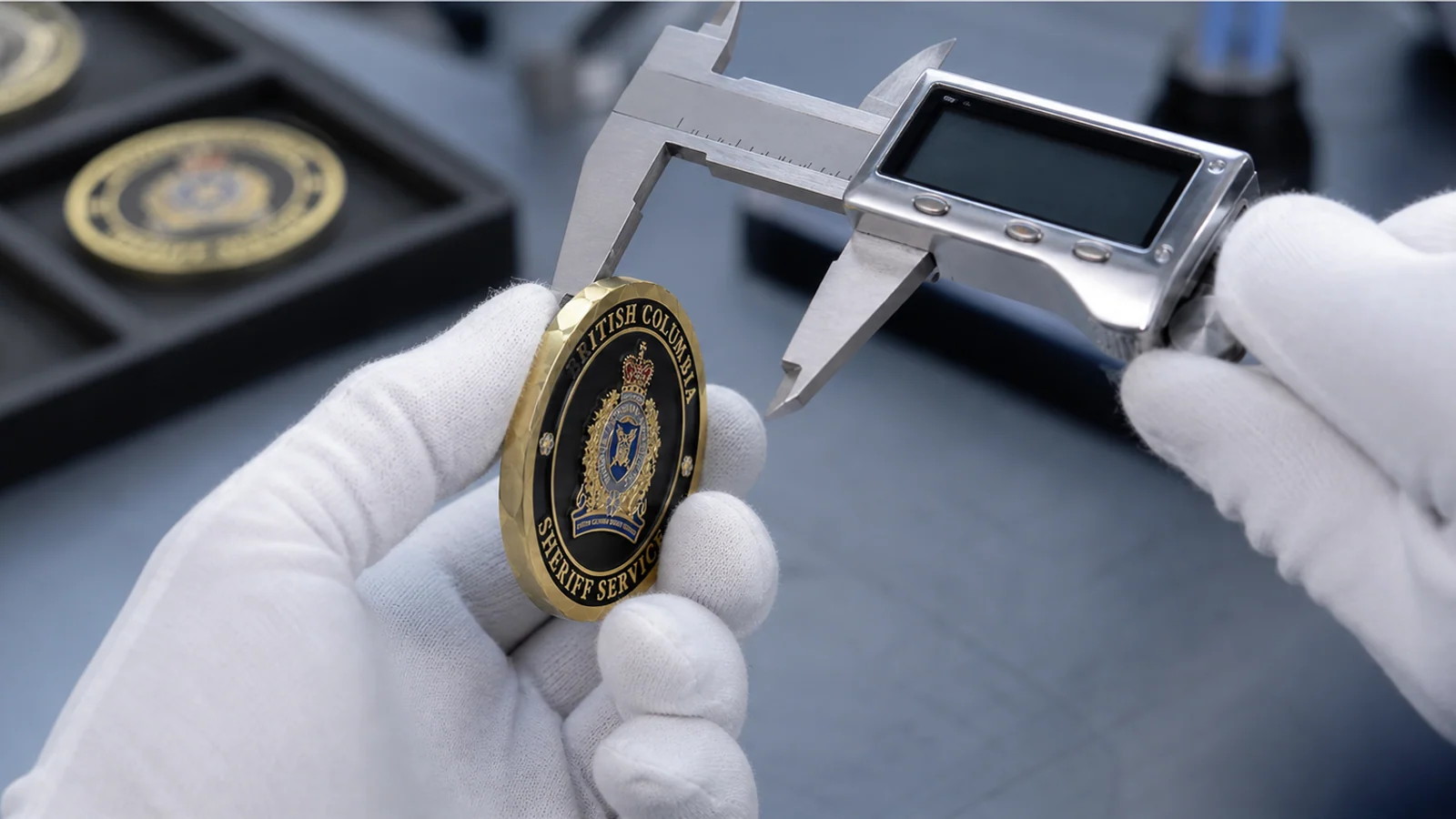
During sample approval or in-process inspection, use a caliper to check diameter, width, height, edge thickness and any specified maximum 3D height. Compare the readings with the approved specification rather than relying on visual judgment.
- Dimensions: Verify the stated diameter or maximum width and height.
- Thickness: Measure the edge and the highest point of the 3D relief identified on the proof.
- Artwork clarity: Check small text, dates, relief separation and enamel boundaries.
- Edge quality: Inspect for sharp areas, uneven polishing, incomplete plating or distorted edge text.
- Surface condition: Check scratches, pits, color overflow, plating variation and unwanted marks.
- Packaging fit: Make sure capsules, pouches, trays and boxes close without pressure on the coin.
- Shipment preparation: Verify quantities, protective packing, carton labels and the approved packaging configuration.
Before tooling, lock the complete specification
The approved proof or purchase specification should show the diameter or maximum width and height, edge thickness, maximum relief height when relevant, front and back artwork, plating, enamel, edge treatment, packaging and quantity. Agree on any important measurement tolerance before mass production, particularly for fitted packaging and mechanical features.
To see how proofing, tooling, finishing, inspection and packing connect, read How Are Custom Challenge Coins Made?
What to Send for a Size Recommendation
A useful recommendation needs more than a preferred diameter. Send the following details so the artwork and production method can be evaluated together:
- Front and back artwork or clear reference images
- Required wording, dates, names and serial-number area
- Intended application and recipient group
- Approximate quantity and delivery country
- Preferred 2D, 3D or mixed construction
- Desired packaging and required arrival date
If size is undecided, ask for two proofs at actual scale. Comparing a 1.75-inch and 2-inch layout using the same content is more informative than comparing unrelated sample photos.
Frequently Asked Questions
What is the standard challenge coin size?
There is no mandatory standard. Common custom sizes range from about 1.5 to 2.5 inches. Start around 1.75 inches for concise pocket-carry designs and 2 inches for more detailed artwork.
Is a 1.75-inch or 2-inch challenge coin better?
Choose 1.75 inches for a clear emblem and limited wording. Choose 2 inches for a detailed seal, several text lines or complex double-sided artwork. Compare both layouts at actual size.
How thick should a challenge coin be?
For standard round coins, our current production reference is 2.0 to 3.0 mm for diameters of 25 to 45 mm, 3.0 to 3.5 mm for 46 to 70 mm, about 3.5 mm for 71 to 90 mm, and 4 mm or more for diameters of 91 mm and above. Artwork, relief and shape can change the final recommendation.
Does a thicker coin always mean better quality?
No. Quality also depends on artwork, tooling, plating, enamel, polishing, inspection and packaging. Extra thickness can add weight without improving readability or finish.
What size is best for a 3D challenge coin?
Many 3D projects benefit from 2 inches or more because sculpted contours need room to transition. Portraits, buildings, vehicles and detailed scenes may require more diameter and relief height than a simple raised emblem.
How is an irregular challenge coin measured?
Specify custom-shaped coins by maximum width and height, with the quoted size tied to the longest dimension. Mark cutouts, narrow sections and projections on the proof.
Conclusion
The right challenge coin size is the smallest manufacturable dimension that keeps the artwork clear. A 1.75-inch coin suits concise pocket-carry designs; 2 inches provides more room for detailed or two-sided coin artwork. Choose larger presentation sizes only when the content or application needs them.
Treat thickness as a separate production decision. Specify the edge, maximum 3D height, packaging fit and inspection method before mass production.
Get a Production-Ready Coin Size Recommendation
Share your artwork, quantity, application, packaging preference and deadline. We can assess the layout and prepare a clear specification for your custom challenge coin project.