
In This Guide
Custom Embroidered Patches with No Minimum: A Pilot Order Guide
 By Sunny Huang
Ordering custom embroidered patches with no minimum lets you start with the quantity your project needs. For a clothing brand, that might mean checking a new logo on a jacket. For a uniform supplier, it might mean preparing samples for a customer's approval before committing to a larger order.
A useful pilot order answers specific questions: Is the artwork readable? Does the patch sit properly on the garment? Is the attachment suitable for its care routine? What needs to change before production expands?
This guide explains how to plan that first order, compare costs, and carry an approved design into bulk production.
What Does “No Minimum” Mean for Custom Embroidered Patches?
No minimum order quantity means you do not have to meet a fixed quantity threshold to place an order. However, the available specifications and total cost still need to be confirmed for your project.
Machine embroidery uses a digitized stitch file containing machine-readable stitching instructions. Ask whether the supplier can reuse an approved file or needs to create or adjust one. Confirm whether file preparation, physical samples, and revisions are included in the quotation or charged separately.
It helps to distinguish a digital proof, a physical sample, and a pilot order; these do not necessarily require three separate orders.
- Digital proof: Shows the proposed artwork, layout, colors, and dimensions for review.
- Physical sample: Lets you inspect the actual thread, fabric, border, and backing.
- Pilot order: A small batch used for garment testing, customer approval, or an initial retail release.
A digital proof cannot demonstrate how a patch feels or performs after attachment. If those details affect your decision, discuss physical sampling before placing the pilot order.
Define What Your Pilot Order Needs to Prove
Start with the decision you need to make. A clothing brand testing a jacket design may need to compare two patch sizes. A uniform supplier may already have approved artwork but need to check installation on different shirt fabrics.
Keep the comparison focused. If you change size, colors, border, and backing together, it becomes harder to identify which change improved the result.
Allocate patches by purpose rather than choosing an arbitrary quantity. Allow for customer review, attachment trials, planned wear or wash checks, and an unused reference sample. If you are testing several garments, include each relevant fabric and construction.
For example, a patch intended for both a work shirt and a jacket should be assessed on both. Approval on the jacket does not establish suitability for the shirt.
If the pilot is also a retail test, track sales by design and record customer comments separately from quality findings. A slow-selling design and an attachment problem require different responses.
Prepare Artwork and Specifications for a Small Batch
Give the supplier enough information to quote and sample the intended product. Your brief should identify:
- The artwork file and its version or revision date.
- Finished width and height, with units clearly stated.
- Intended garment, fabric, and patch position.
- Preferred thread colors, background fabric, border, and backing.
- Quantity per design, packaging needs, and required arrival date.
Review the logo at its intended finished size. Small lettering, narrow gaps, and fine outlines may need adjustment when translated into stitches. Ask the supplier to flag details that could lose clarity before approving the proof.
If your clothing range uses several logo sizes, review the smallest version first. A mark that reads clearly across a jacket back may need simpler artwork on a chest patch. If essential detail cannot be retained, discuss a larger patch or another construction, such as woven patches.
Use the patch shapes guide to narrow the outline and border choice. Record the selected version so an earlier proof is not accidentally used for sampling.
Test Patch Samples on the Actual Garments
Evaluate custom embroidered patch samples on the same garment model and fabric intended for the finished order. Look at the placement while the garment is worn, not only while it lies flat. Check nearby seams, pockets, folds, and areas that stretch during movement.
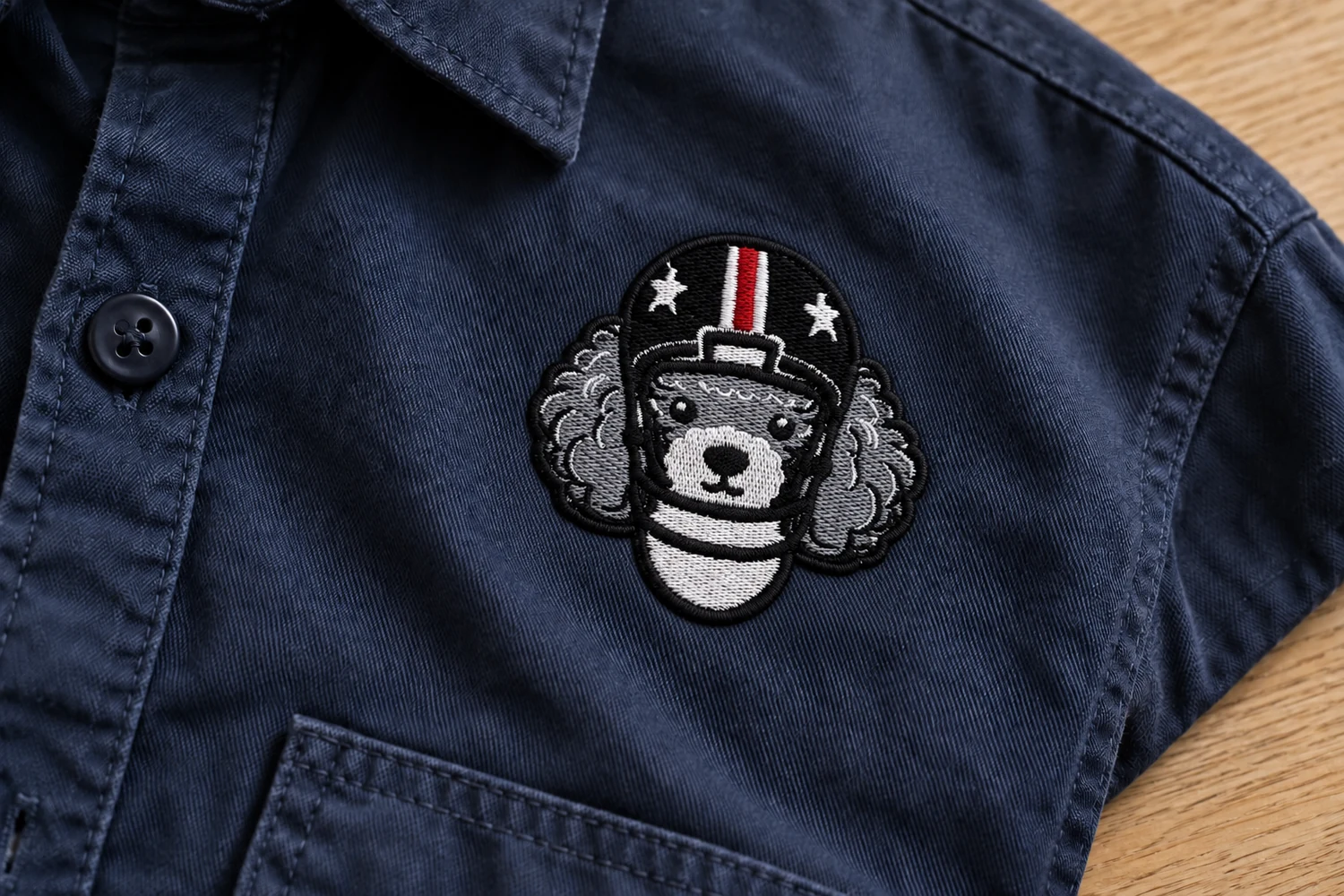
Choose the attachment method around the application. Sew-on patches require a suitable stitching method and access to the installation area. Heat-applied backing needs compatibility with the garment and the specified application conditions. Hook-and-loop patches need a matching receiving panel and a plan for attaching it.
For heat application, use the backing supplier's instructions together with the garment's care restrictions. Do not assume one temperature, pressure, or pressing time works for every patch and fabric.
Use a simple record to connect observations with decisions:
| Check | What to record | Decision before a larger order |
|---|---|---|
| Artwork | Readability, spacing, and visible stitch detail | Keep or revise the design |
| Appearance | Dimensions, thread colors, and border shape | Confirm the approved specification |
| Installation | Garment model, position, backing, and application method | Approve or adjust the attachment |
| Wear and care | Test conditions and changes to edges, stitches, or attachment | Investigate issues before proceeding |
Agree on a care test that reflects the intended use. Before testing, agree with the customer and supplier which changes in appearance, edge condition, and attachment would require correction. Record the outcome against those criteria before approving the larger order.
Record washing and drying conditions and compare the result with the unused sample. A home wash trial should not be treated as evidence of suitability for an industrial laundry process.
For custom uniform patches, ask the customer to approve the installed sample. Their decision should cover placement and appearance as well as the loose patch itself.
Compare Pilot and Bulk Order Costs
Request pilot and bulk quotations against the same specifications. Otherwise, a lower price may reflect a different size, backing, packaging format, or embroidery coverage—the proportion of the patch face covered by stitches.
Check how the quotation handles:
- Artwork preparation or digitizing.
- Physical samples and requested revisions.
- Patch production, backing, and any attachment work.
- Packaging and shipping, plus any import charges included in the quote or payable separately.
Also ask which charges may recur on a reorder. Reusing an approved design may reduce preparation work, but changes to dimensions, construction, or artwork can require further review.
Smaller batches often have a higher cost per patch because preparation and shipping costs are spread across fewer pieces. Compare the total amount you must commit, alongside unit price, before increasing the order solely to reach a cheaper price tier.
Plan the schedule around the date the patches must arrive. Allow separately for proof review, sampling, your garment tests, revisions, production, and shipping. Confirm the current schedule when the specifications are settled.
Approve the Final Sample Before Scaling Up
Before ordering bulk embroidered patches, create one approval record that both buyer and supplier can reference. Include the final artwork, dimensions, thread color references, background fabric, border, backing, quantities by version, and packaging instructions.
Record who approved the final version and when, and identify the approved sample in the written authorization for bulk production.
Identify the approved physical sample and retain it for comparison. Photographs help document placement and appearance, but keep a physical reference when texture or color is important.
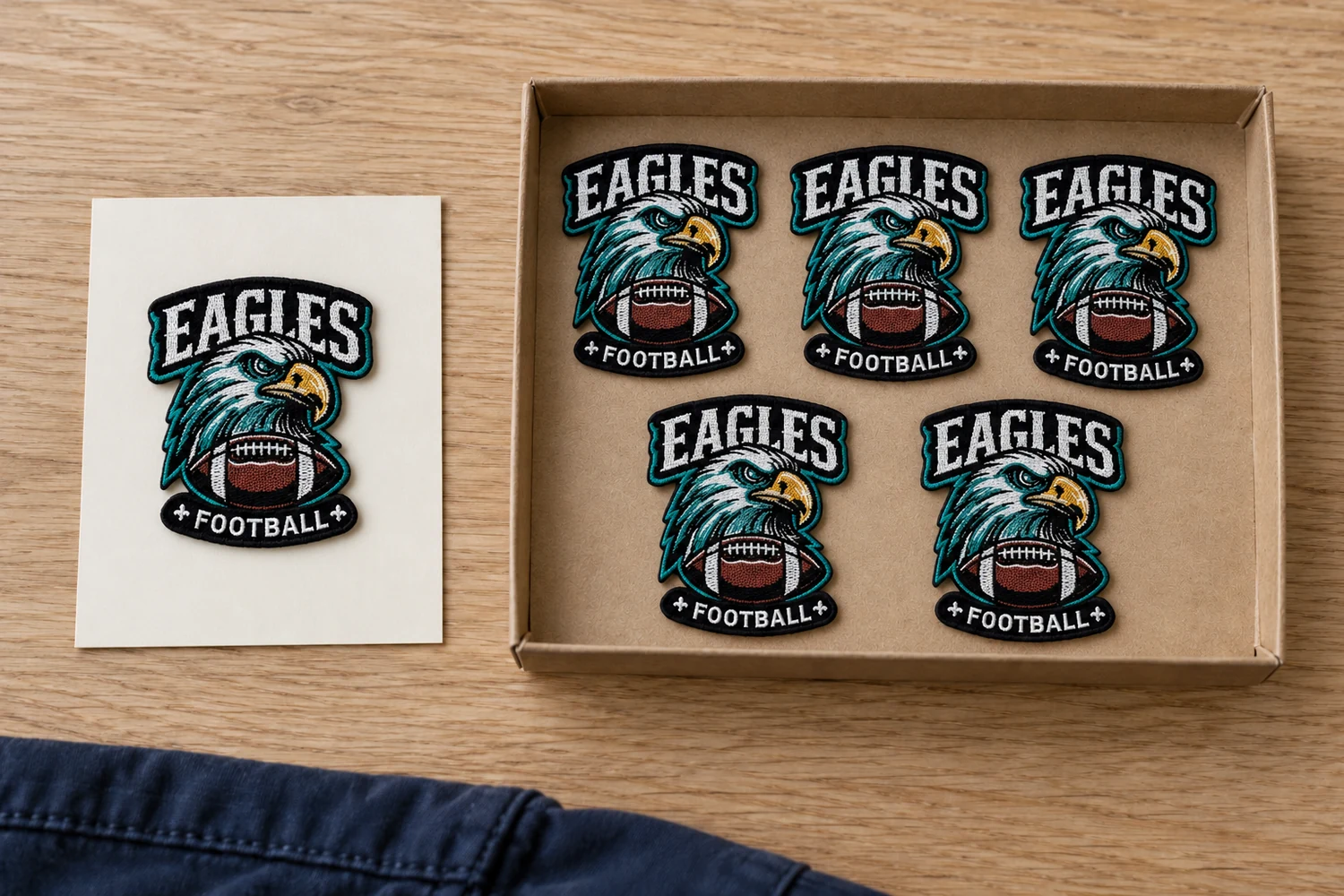
Approve the larger order when the artwork, installed appearance, and agreed care-test results meet your requirements, and the customer has accepted the final version where applicable.
Resolve any remaining design or attachment issues before giving production approval. Ordering more pieces should not imply approval of an unresolved defect.
For future reorders, reference the previous order and approved specification. Ask the supplier to flag material substitutions or production changes that could affect the result. When the bulk shipment arrives, compare it with the agreed reference. Check quantities, artwork versions, and backings against the order before distributing patches or attaching them to garments.
Frequently Asked Questions
Can I order just one custom embroidered patch?
A no-minimum service can accommodate a single-piece request, but confirm the selected construction, backing, and total price. A one-piece order may be useful for inspection; additional pieces may be needed for attachment testing and retaining a reference.
Is a physical sample included with a free digital proof?
Not necessarily. A digital proof and a physical sample are separate deliverables. Ask what the quoted service includes, whether sample shipping is additional, and how revisions are charged.
How many patches should I order for a pilot run?
Base the quantity on the number of designs, garment types, approval recipients, and planned tests. Reserve an unused sample. There is no single pilot quantity that suits every apparel project.
Will a repeat order match the first batch exactly?
An approved sample and recorded specifications provide a comparison reference, but they do not guarantee identical results across batches. Agree how dimensions, thread colors, and border appearance will be compared with the approved sample, including acceptable differences. Confirm any specification changes before a reorder proceeds.
Request a Small-Batch Patch Quote
Share your artwork, patch dimensions, garment details, preferred backing, pilot quantity, and required arrival date with Unique Pin. Include your anticipated bulk quantity if known. Explore our custom patches and request a quote for the specifications you want to test.
Ready to Plan Your Patch Order?
Share your artwork, backing preferences, pilot quantity and required arrival date through our contact form.