Years of Service Lapel Pins: Should Every Milestone Look the Same?
 By Sunny Huang
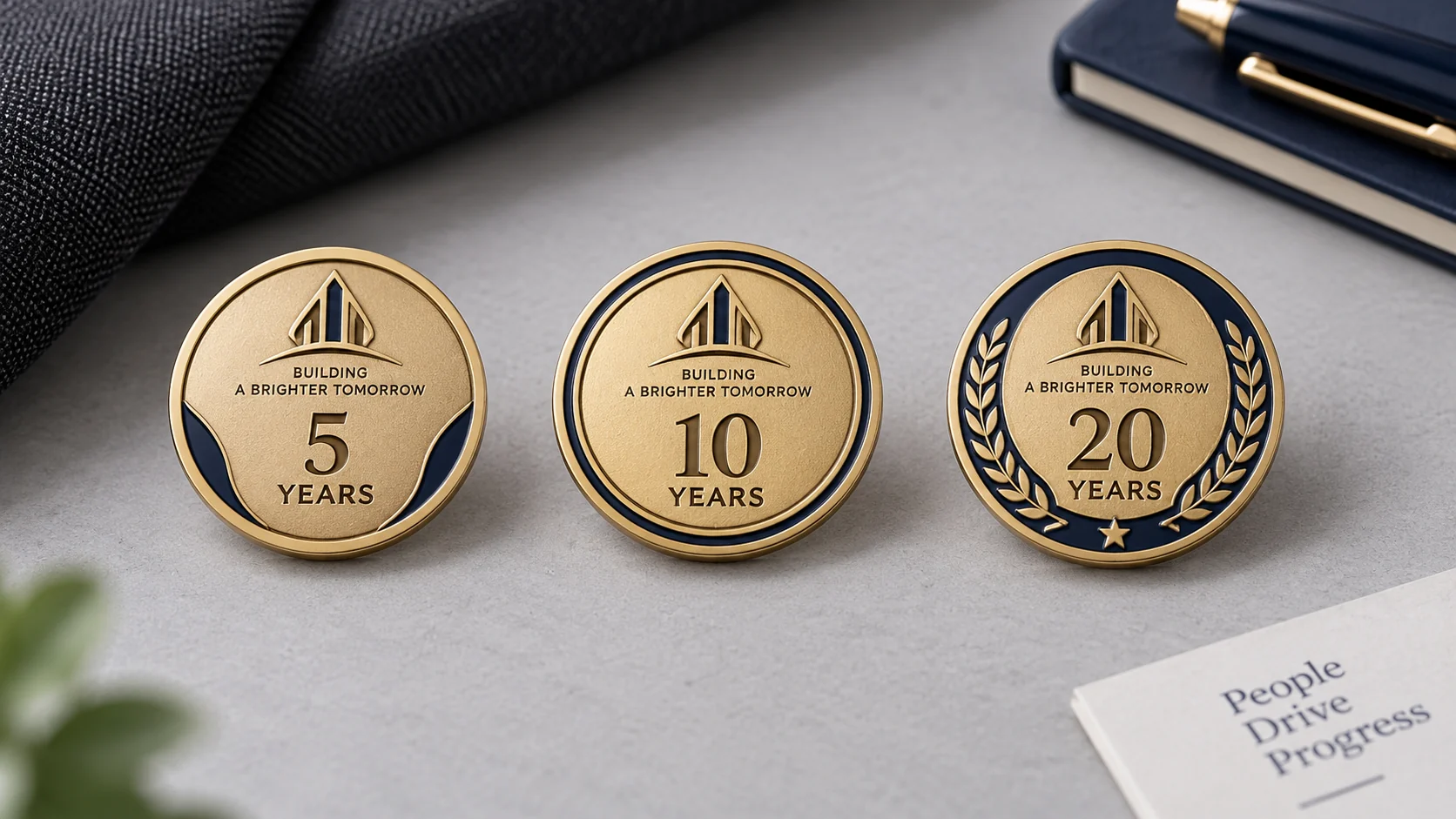
Imagine a U.S. company preparing to recognize 28 employees at its annual service awards. Eighteen have completed five years, seven have reached ten years, and three are celebrating twenty. HR wants each milestone to receive appropriate recognition, while the branding team wants every lapel pin to reflect the same company identity. Is changing the year number enough? And when employees reach their next milestone, should they replace their previous pins or keep them?
These decisions shape how employees receive, wear, and remember their awards. This article explores which service milestones may warrant dedicated pins, how different versions can remain visually connected, and how companies can maintain a consistent recognition program as their workforce changes.
Not every milestone needs a completely different pin. Keep the company emblem and overall design consistent, then change the year number—or a restrained design detail—when the pin itself needs to identify the milestone.
In This Guide
What Should a Years-of-Service Pin Represent?
A years-of-service pin recognizes an employee's length of service with an organization. It acknowledges an established employment milestone rather than job performance, seniority in a management hierarchy, or individual sales results. A technician and a department manager who have each completed ten years may therefore receive the same service award.
A 20-year service pin does not mean its recipient performs better than someone wearing a five-year pin. The distinction is the time each employee has spent with the organization. Outstanding performance, leadership, and other achievements can be recognized through separate awards rather than being implied by service-year numbers.
This distinction matters when deciding what appears on the pin. If the company wants the award to communicate service length, the milestone should be identifiable. Job titles and performance rankings do not need to become part of the same design.
Which Service Milestones Deserve Their Own Pins?
Not every work anniversary needs a new lapel pin. Some organizations begin recognizing employees after their first year, while others reserve dedicated pins for three-, five-, ten-, or twenty-year milestones. There is no universal schedule that every employer must follow. The right intervals depend on the organization's recognition traditions, workforce, and intended purpose.
Before selecting milestone years, HR should consider the trade-offs between recognizing employees early and reserving awards for longer periods of service.
| Milestone Strategy | Potential Advantage | Trade-Off |
|---|---|---|
| Early Recognition | Acknowledges employees within their first few years and creates an early recognition opportunity. | More frequent milestones may require additional administration and award presentations. |
| Five-Year Intervals | Establishes a predictable tradition that can continue across successive employee groups. | Employees may wait several years between dedicated service awards. |
| Major Anniversaries Only | Gives particular attention to longer service periods, such as 10 or 20 years. | Employees with shorter service may not receive a dedicated pin. |
For example, a growing company might begin with five-year recognition, while an organization with an established anniversary tradition may already have specific milestones in place. The objective is not to introduce as many pin versions as possible, but to choose occasions the company intends to recognize consistently.
One Company Logo: One Pin Design or Separate Milestone Versions?
Using one identical company pin for every milestone is the simplest visual approach. It emphasizes membership in the organization, but the pin itself does not reveal whether the employee has served five, ten, or twenty years. The milestone would need to be communicated through the presentation, an accompanying certificate, or another form of recognition.
A second option keeps the company logo, pin shape, and general arrangement unchanged while displaying a different service-year number. A prominent 5 YEARS, 10 YEARS, or 20 YEARS inscription can make the distinction easier to identify when viewed up close. This approach suits companies that want employees to recognize the same corporate design across different service periods.
A third option introduces modest changes to borders, symbols, or company-approved colors for selected anniversaries. This may be useful when the organization wants a twentieth anniversary to feel more distinctive than an earlier milestone. The differences should support that intention without making the pins appear to represent unrelated companies.
Separate designs are not essential for every milestone. They become useful when the organization wants the pin itself—not just the award announcement—to identify the service anniversary.
Before approving the series, ask the manufacturer how each milestone will be produced. A changed year number, border, or emblem may require different tooling or decoration, depending on the construction. Request quantities and setup costs by version rather than assuming all milestones can share one production setup.
What Happens to an Employee's Pin at the Next Milestone?
An employee receives a five-year service pin and later qualifies for a ten-year award. Does the company issue another pin? If so, should the employee stop wearing the earlier one?
These are two separate decisions: what the company awards at a new milestone and what employees wear or keep afterward. A replacement-wearing policy does not mean the older pin must be surrendered, and building a collection does not mean wearing every pin at once.
| Recognition Approach | What Happens at the Next Milestone? | Everyday Wear | Earlier Pins |
|---|---|---|---|
| Permanent Company Pin | The employee continues using the existing pin; later anniversaries may be recognized in another way. | The same company pin remains in use. | The original pin stays with the employee. |
| Milestone Upgrade | A new pin identifies the employee's latest recognized service year. | The current milestone version replaces the earlier one for regular wear. | Earlier versions may be retained as keepsakes. |
| Collectible Milestone Series | A new coordinated pin is added at each designated milestone. | The employee may wear the latest version or follow the company's dress guidelines. | Previous versions form a personal collection. |
The upgrade and collectible approaches can overlap. A company might issue new pins at five, ten, and twenty years, ask employees to wear only their most recent milestone, and encourage them to keep earlier awards.
That distinction is particularly relevant for employees wearing pins on business jackets or uniforms. One visible service pin may suit the workplace better than several displayed together, while a collection can still preserve the employee's history with the company.
For uniforms and jackets with different fabrics, our lapel pin attachment guide covers the available backing options.
How Should 5-, 10- and 20-Year Service Pins Differ?
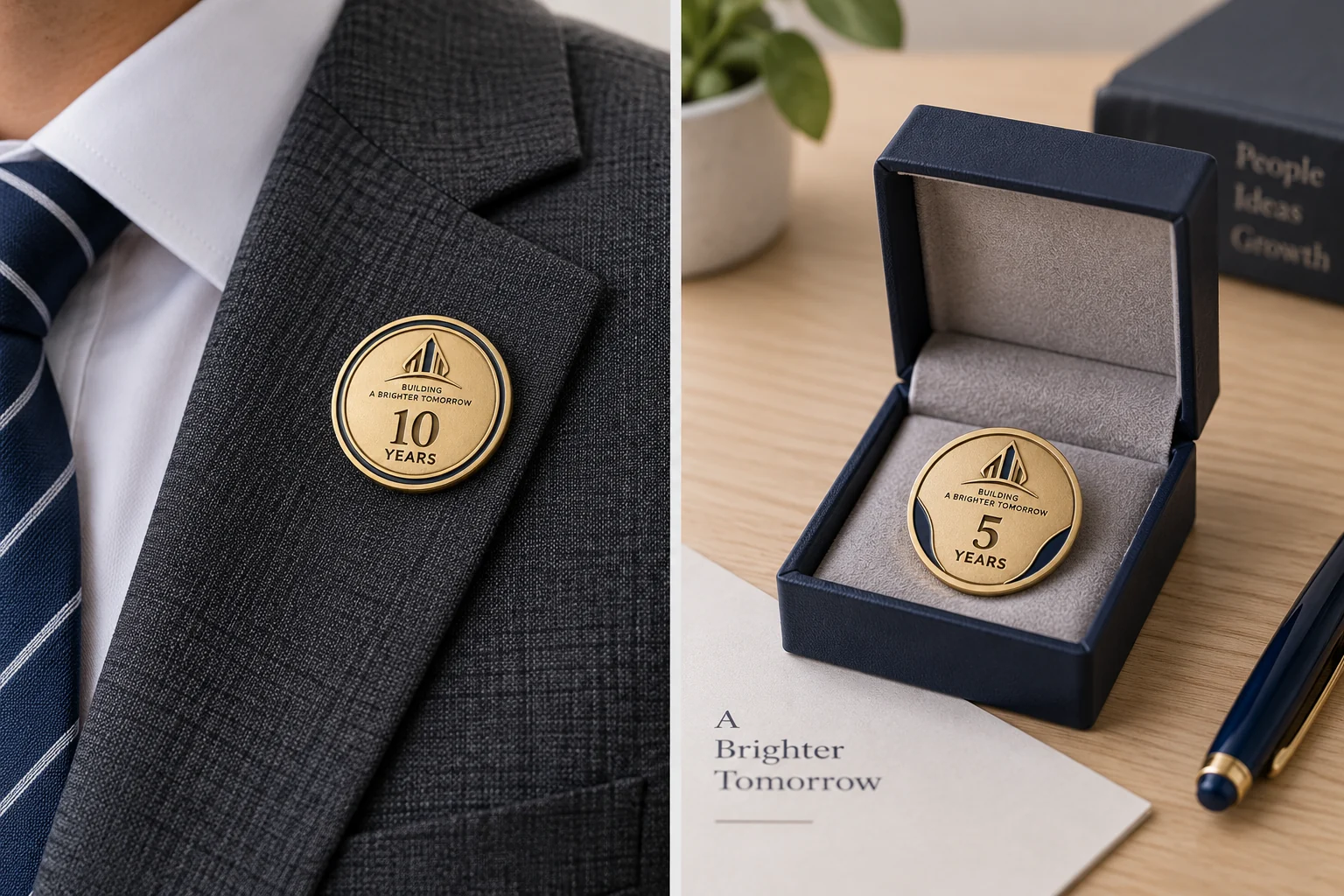
Consider three lapel pins for a fictional company. The 5 Years version establishes the collection: a recognizable corporate emblem paired with a clear service-year number. It should work as a complete award on its own, rather than looking like an unfinished version of a higher milestone.
The 10 Years pin could retain that emblem and layout while introducing a subtle anniversary border. For 20 Years, the company might use a distinctive laurel detail around the same central emblem. These changes give the longer milestones their own appearance without replacing the original corporate identity.
The designs should also make sense at normal wearing size. A border variation that looks impressive in an enlarged illustration may be difficult to notice on a jacket lapel. The service-year number and the shared emblem should remain the most recognizable features.
There is no industry requirement for five-year pins to be silver, ten-year pins to be gold, or twenty-year pins to feature gemstones. Those choices are matters of company tradition and brand preference, not universal service-award rankings.
Companies considering a coordinated series can explore different possibilities through our custom enamel pins collection.
A Three-Tier Service Pin Program for a Growing Company
For the 28 employees in our illustrative company, HR could establish a three-tier recognition arrangement. Each group would receive a pin identifying its completed service milestone, while the presentation could reflect how the organization normally acknowledges those anniversaries.
| Milestone | Employees | Pin Design | Example Presentation |
|---|---|---|---|
| 5 Years | 18 | Shared corporate emblem with 5 YEARS | Recognition within the employee's team |
| 10 Years | 7 | Matching emblem with a distinctive border and 10 YEARS | Department gathering |
| 20 Years | 3 | Coordinated anniversary design with 20 YEARS and a laurel detail | Company-wide anniversary event |
| Total | 28 | Three milestone versions |
These presentation examples are illustrative only. The pin design should support the organization's existing recognition program; the supplier does not determine which service milestone warrants team-, department-, or company-level recognition.
If each eligible employee receives one current-milestone pin, this example calls for 18 five-year pins, seven ten-year pins, and three twenty-year pins: 28 pieces across three designs. These are recognition quantities, not confirmed production or purchasing quantities.
Use these recipient counts as the starting point for quotation. Ask the supplier to confirm feasible quantities and pricing for each version, then decide whether any additional pieces are needed for replacements or future awards. Keep those additional quantities separate from the confirmed recipient list.
What Happens When New Employees Reach Milestones Next Year?
Service milestone numbers change as employees move through their careers. A company recognizing 18 five-year employees this year might have nine reaching that anniversary next year and 22 the year after. Requirements for ten- and twenty-year pins will change independently as well.
Instead of redesigning the collection annually, HR can maintain a record of approved milestone versions. Each design can have a clear identifier, such as SERVICE-05, SERVICE-10, or SERVICE-20, linked to the approved artwork and corresponding recognition category. Internal employee records can track which milestones have already been awarded, while workforce planning provides an estimate of upcoming recipients.
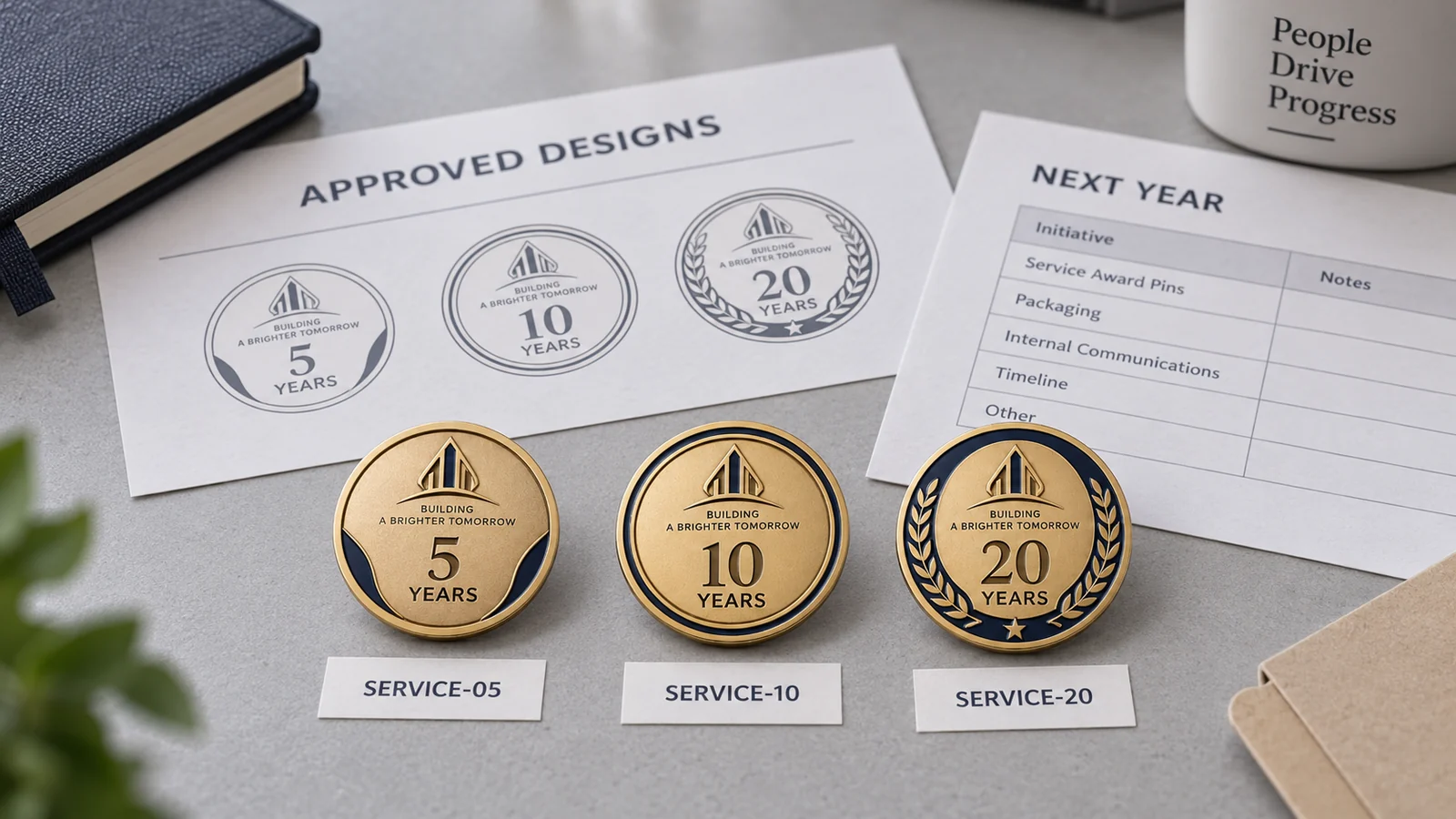
Keeping these records makes future discussions with the purchasing team and manufacturer more straightforward. Existing artwork provides a useful reference for repeat orders, although production details and availability should be reconfirmed when a new order is placed. A service pin collection should be able to accommodate changing employee numbers without requiring a completely new design program each year.
Frequently Asked Questions About Years-of-Service Pins
Should employees wear only their latest service pin?
That depends on company guidelines. Employees may wear their current milestone pin while keeping earlier versions as personal mementos. Collecting previous awards does not require wearing them together.
Can a company introduce service pins when employees have already passed several milestones?
Yes. HR can decide whether to recognize employees at their current service level or also acknowledge earlier anniversaries. The policy should be consistent and clearly communicated.
Can the same milestone pin designs be reordered in future years?
Matching designs can be discussed for future orders. Retaining approved artwork and version records helps maintain consistency, while current production details should be confirmed with the manufacturer.
A Service Pin Should Reflect More Than a Number
A years-of-service pin should make an employee's milestone recognizable while remaining connected to the organization. Whether the company uses one permanent design, milestone upgrades, or a collectible series, the recognition and wearing policies should guide the design choices.
Planning a Years-of-Service Pin Collection?
Whether you're introducing service pins for the first time or updating an existing milestone series, share your company logo, recognition years, and estimated recipients with Unique Pin. We can discuss how different pin versions could fit your program.